
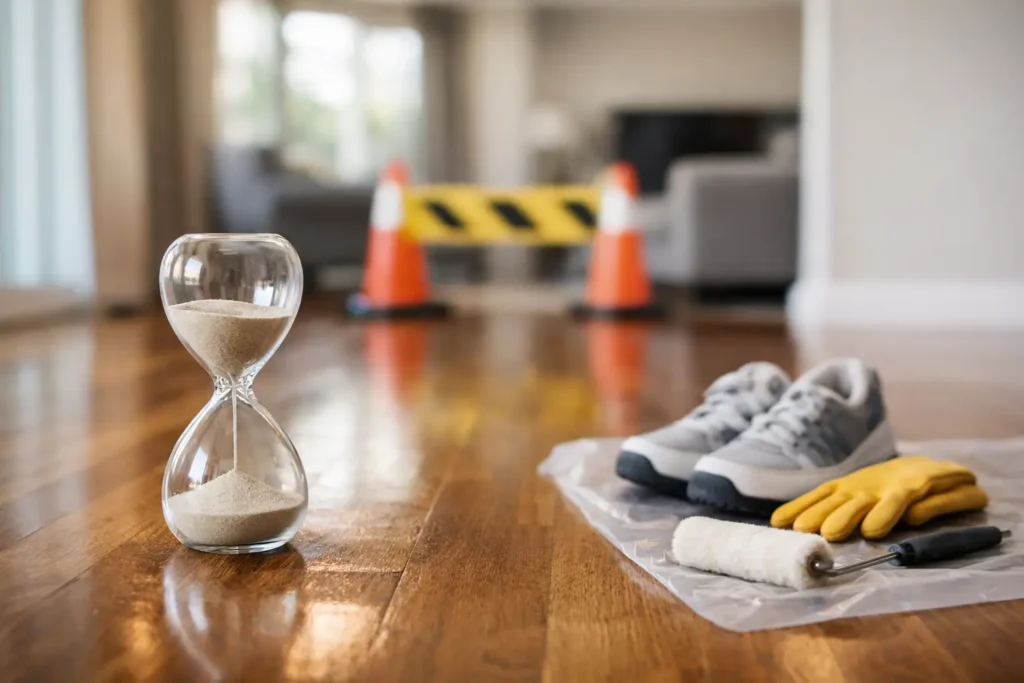
You only refinish hardwood floors a few times over the life of your home, so the waiting period matters. If you’re asking how long to stay off refinished floors, the short answer is this: light foot traffic is often safe after 24 hours. Socks-only use usually lasts several days. Full curing can take up to 30 days depending on the finish used.
Understanding how long to stay off refinished floors is crucial for the longevity of your hardwood. Always remember to prioritize this when planning your flooring project.
Knowing how long to stay off refinished floors can save you from premature damage, ensuring your investment lasts.
That said, the real answer depends on the type of finish, your home’s temperature and humidity, and what you mean by “stay off.” Walking carefully to get through the room is very different from moving furniture back in, letting pets run across the floor, or laying down rugs too soon. A beautiful result lasts longer when the first few days are handled correctly.
How long to stay off refinished floors depends on the finish
Ultimately, how long to stay off refinished floors is determined by the specific finishing product used.
For lasting results, always consider how long to stay off refinished floors before introducing regular foot traffic.
Not all floor finishes dry and cure at the same speed. Dry to the touch, safe for light traffic, and fully cured are three different milestones, and homeowners often mix them up.
Many homeowners wonder how long to stay off refinished floors after the finishing touch is applied.
To ensure the best outcome, ask your contractor how long to stay off refinished floors based on current conditions.
During the first 24 hours, it’s vital to know how long to stay off refinished floors to avoid any imprints.
Keep in mind how long to stay off refinished floors to guarantee a successful finish.
Remember that knowing how long to stay off refinished floors also impacts your overall satisfaction with the project.
Oil-based polyurethane usually takes longer. In many homes, you should plan on waiting at least 24 hours before very light foot traffic, and often longer before normal use. Water-based polyurethane tends to dry faster, which is one reason many homeowners prefer it when they want a quicker return to everyday life. Even then, faster drying does not mean instant durability.
Many ask how long to stay off refinished floors, and it’s essential to provide accurate advice.
A floor may look finished within hours, but the coating underneath can still be soft. That softness is what makes early traffic risky. Shoes can leave impressions, pet nails can mark the surface, and furniture legs can press into a finish that has not hardened enough.
If you’re unsure how long to stay off refinished floors, consult your refinishing expert.
This is why professional refinishing crews give aftercare instructions based on the exact products used in your home, not a one-size-fits-all rule.
Ultimately, knowing how long to stay off refinished floors can help prevent damage and ensure a beautiful finish.
Inquire about how long to stay off refinished floors when scheduling any household activities during the curing period.
Being informed about how long to stay off refinished floors also allows you to plan family activities around the refinishing timeline.
Typical timeline after hardwood floor refinishing
For most refinished hardwood floors, it helps to think in phases instead of a single waiting period.
First 24 hours
Finally, knowing how long to stay off refinished floors ensures that you can maintain a clean and safe environment.
It’s crucial to understand how long to stay off refinished floors to protect your investment.
Be sure to ask how long to stay off refinished floors when the renovations are complete.
In busy households, knowing how long to stay off refinished floors is essential for maintaining order.
In the first day, the finish is at its most vulnerable. In many cases, the floor should be completely avoided or used only if your contractor says it is safe. If entry is necessary, clean socks are usually the best option. Bare feet can leave oils behind, and shoes can scuff or trap grit.
To protect your new floors, understand how long to stay off refinished floors during this critical period.
After 24 to 48 hours
This is when many floors can handle very light foot traffic. The key word is light. Walking carefully across the room is not the same as regular family traffic, hosting guests, or letting children and pets use the space normally.
After 3 to 7 days
Many finishes are ready for more normal use during this window, but with caution. Furniture may be moved back in if it has proper felt protection and if your refinishing professional says the floor is ready. Heavy dragging is never safe, even after the finish feels dry.
After 2 to 4 weeks
This is often the full cure window, especially for oil-based systems. Rugs should usually wait until this point because they can trap solvents and slow the curing process. Full hardness takes time, and patience here protects the work you paid for.
What “staying off” really means
When homeowners hear “stay off the floor,” they often picture a room that is totally off-limits. Sometimes that is true for the first stage, but usually the bigger issue is how the floor is used.
Light sock-only traffic is very different from everyday wear. A person walking gently to reach a bedroom is not applying the same stress as a dog sprinting across the room or a dining chair scraping backward. The floor doesn’t just need to dry. It needs time to build strength.
That is why careful use matters just as much as the calendar. If your contractor says the floor can handle light traffic after a day, that does not mean it is ready for normal life in every respect.
When can you put furniture back?
Furniture timing is one of the most common questions after refinishing, and it is where people accidentally damage new floors. In many cases, lightweight furniture can return after a few days, while heavier items may need more time.
The safest approach is to wait for direct guidance based on the finish used and the conditions in your home. Every chair, table, and sofa should have clean felt pads before it goes back. Even then, furniture should be lifted, never pushed or dragged.
Large pieces can trap air around the floor and put pressure on areas that are still curing. If the finish is not ready, that pressure can leave marks that are difficult to fix without additional work.
When can pets and kids use the floor normally?
Families usually want to know when life can go back to normal, especially in busy homes with children and pets. The honest answer is that normal should return gradually.
Kids may forget and slide toys, push stools, or run through the room. Pets can be even harder on a new finish because claws create concentrated pressure. Even if the floor is technically dry enough to walk on, it may not be hard enough for rougher activity.
If possible, keep pets off refinished floors for several days or longer if advised. For children, calm sock-only walking is better than active play until the finish has had more time to harden.
How humidity and temperature affect drying time
Connecticut homeowners often deal with seasonal humidity swings, and that can change the timeline. A floor refinished during a humid summer stretch may take longer to dry and cure than the same floor finished during a milder, controlled indoor season.
Cool temperatures can also slow the process. If your home’s airflow is limited or indoor humidity is high, the finish may remain softer for longer than expected. That is one reason generic online timelines can only go so far.
A professional contractor will consider the actual site conditions before giving you a reentry plan. That matters because the wrong timing can affect both appearance and long-term durability.
How long to stay off refinished floors if rugs are involved
Rugs deserve their own warning because they are often placed back too early. Even when a floor seems dry, area rugs can trap curing vapors and prevent the finish from hardening evenly.
As a rule, it is smarter to wait at least two weeks, and often closer to 30 days, before putting rugs back down. This is especially true for larger rugs and rug pads that cover a lot of surface area. Early rug placement can cause discoloration, uneven curing, or bonding issues that affect the final look.
If you’re unsure, waiting longer is usually the safer choice.
Why professional aftercare instructions matter
The internet can give you averages, but your floor needs advice based on the actual finish system used in your home. The number of coats, drying conditions, wood species, and traffic level all matter.
That is why professional refinishing should always come with clear guidance on when to walk on the floor, when to return furniture, and when to resume normal use. Homeowners should not have to guess.
For Connecticut families, there is also the comfort factor. A professional dustless sanding and refinishing process keeps the home clean throughout the project, with zero dust left behind in the home. That makes the experience far easier for families, children, pets, and allergy-sensitive households. Clean results are not just about appearance. They make the entire refinishing process feel more manageable from start to finish.
At Dustless Hardwood Floors LLC, that dustless standard is central to the service because homeowners should be able to enjoy beautifully restored floors without the stress of residue drifting through the house.
Best habits for protecting newly refinished floors
The first month is when good habits pay off most. Stick to socks at first, keep pet nails trimmed, lift furniture carefully, and delay rugs until the finish is fully cured.
It also helps to avoid wet cleaning too soon unless your contractor specifically says it is safe.
If something spills, wipe it gently with a soft dry or barely damp cloth based on the care instructions you were given. Strong cleaners and too much moisture can interfere with a finish that is still curing.
The goal is simple: treat the floor like it looks finished, but remember it is still hardening underneath.
A refinished hardwood floor can completely change a room, but the final step is patience. Give it the right amount of time now, and you’ll get more beauty, better durability, and fewer regrets every time you walk across it.