
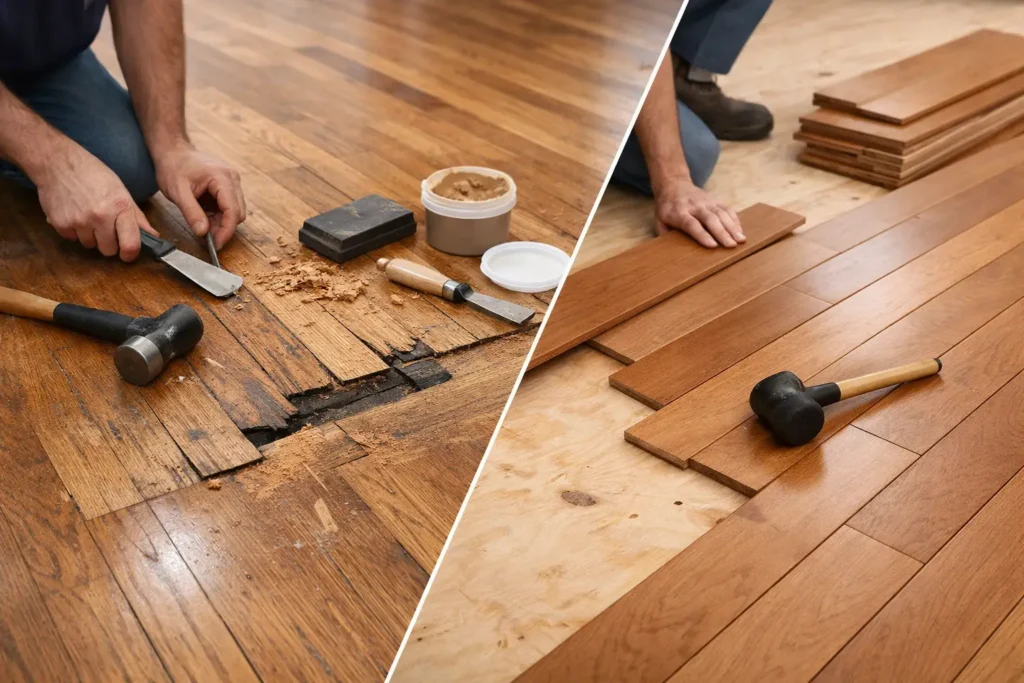
A few deep scratches near the entry, some pet stains by the back door, a soft board under the refrigerator – this is where the hardwood repair vs full replacement decision starts for most homeowners. The right answer is not always the biggest project. In many Connecticut homes, targeted repair followed by dustless sanding and refinishing can restore the floor beautifully without replacing rooms of perfectly usable wood.
The key is knowing what kind of damage you are looking at, how far it spreads, and whether the floor still has enough life left to justify restoration. For some floors, repair protects your investment and preserves character. For others, replacement is the smarter long-term move.
When hardwood repair makes more sense
Repair is often the better option when the damage is isolated. A few broken boards, localized water staining, surface scratches, minor cupping, small gaps, and worn finish in high-traffic areas do not automatically mean the entire floor has failed. If most of the floor is structurally sound, professional board replacement and refinishing can bring the whole space back into balance.
This is especially true in older Connecticut homes where the existing hardwood has real character and quality. If the wood species, plank width, and overall layout are worth preserving, repairing damaged sections usually makes more financial and aesthetic sense than starting over. You keep the original floor, avoid unnecessary demolition, and still get a fresh, updated surface.
Repair also works well when the subfloor is stable and the problem sits mostly in the top layer of the flooring. Deep gouges, old pet spots, fading from sunlight, and finish wear can often be corrected through selective repairs and a complete refinishing process. With a true dustless sanding system, homeowners get renewed floors without filling the home with airborne dust. That matters for busy families, children, pets, and anyone sensitive to indoor air quality.
When full replacement is the better investment
Sometimes a floor is simply too far gone for repair to deliver a reliable result. Widespread water damage, major buckling, repeated patchwork from past repairs, severe structural movement, or wood that has already been sanded too many times can make replacement the better choice.
The same is true when damage affects a large percentage of the room. If boards are failing in many areas, if matching the old wood is unrealistic, or if the floor system underneath has moisture problems, replacement can save money over time by solving the root issue instead of extending it.
Homeowners also choose replacement when they want a major layout or design change. Maybe the existing floor is a low-grade material that never wore well. Maybe there are multiple mismatched flooring types across connected rooms. In those cases, replacing the floor creates a more consistent look and may improve long-term durability.
Still, replacement is not automatically the premium option. It is simply the right option when repair cannot produce a strong, lasting finish.
Hardwood repair vs full replacement: what decides it?
The biggest factor is not how the floor looks on the worst board. It is how the floor performs as a whole. A professional evaluation usually looks at four things: the extent of damage, the condition of the subfloor, the remaining thickness of the hardwood, and how closely new material can be integrated with the old.
If only 10 to 20 percent of the floor is affected, repair is often worth serious consideration. If the damage is closer to half the room or more, replacement starts to become more practical. That is not a hard rule, but it is a useful way to think about the decision.
Age matters too, but not in the way many homeowners assume. An older hardwood floor is not a problem if it has solid wood thickness left and the boards remain stable. In fact, many older floors respond extremely well to repair and refinishing. On the other hand, a newer floor with moisture damage or low-quality material may need replacement much sooner than expected.
The type of damage changes the answer
Surface wear is usually the easiest issue to fix. Scratches, dull finish, minor stains, and everyday traffic patterns are classic refinishing candidates. A few damaged boards can often be removed and replaced before the floor is sanded and coated for a uniform final look.
Water damage is more complicated. A small, contained leak that affected a limited area may be repairable. Long-term moisture infiltration that caused widespread staining, warping, mold concerns, or subfloor problems pushes the decision toward replacement.
Structural movement is another red flag. If the floor flexes, separates significantly, or shows recurring movement from below, cosmetic repair alone will not solve the problem. The source has to be addressed first.
Cost is important, but value matters more
Many homeowners begin with budget, and that is reasonable. Repair is usually less expensive than full replacement, especially when the existing floor can be saved with selective board work and dustless refinishing. But short-term savings only matter if the result holds up.
A cheaper repair that does not address the true condition of the floor can turn into a more expensive replacement later. At the same time, replacing an entire floor when a professional repair would have restored it is also wasted money. The smartest choice is the one that gives you a beautiful result and a realistic lifespan.
For Connecticut property owners preparing a home for sale or updating a rental, this distinction matters. Repair and refinishing can often deliver the visual impact buyers and tenants notice most, while keeping the project efficient. In higher-damage situations, replacement may be the cleaner investment because it reduces future maintenance issues and helps standardize flooring across the property.
Appearance matters more than most people think
Homeowners often worry that repaired hardwood will always look patched. That can happen if repairs are done poorly or the floor is not refinished properly afterward. But when board replacement is matched carefully and the entire surface is dustless sanded and refinished, the transition can be far less noticeable than people expect.
That is one reason professional refinishing matters so much. The final color, sheen, and texture help blend repaired sections into the surrounding floor. A dustless sanding system is especially valuable here because it allows for a cleaner, more controlled restoration process inside the home. For families who want the beauty of renewed hardwood without residue circulating through living spaces, that difference is not minor – it is central to the experience.
Full replacement, of course, gives you complete design freedom. You can change species, plank width, stain color, and finish level. If your current floor feels dated or inconsistent from room to room, replacement gives you a fresh start. The trade-off is that you lose the original material and take on a larger project.
What a professional inspection should tell you
A worthwhile inspection should do more than quote a price. It should explain whether the damaged boards are isolated or systemic, whether the subfloor shows signs of trouble, and whether the existing hardwood has enough wear layer left for sanding and refinishing.
You should also get a realistic explanation of what the finished floor will look like. Can the repair blend well? Will old and new boards accept stain similarly? Is a room-by-room strategy possible, or is continuity across connected spaces the better approach? These are the questions that separate a rushed estimate from sound guidance.
For homeowners in Manchester, West Hartford, Glastonbury, and surrounding Hartford County communities, this is where local experience helps. Connecticut homes vary widely in age, wood type, and seasonal movement. A contractor who understands those conditions can spot when a floor is a good repair candidate and when replacement is the safer recommendation.
The best middle ground is often repair plus dustless refinishing
There is a reason many floors do not fall cleanly into a repair-only or replace-only category. Often, the best outcome comes from replacing only the damaged boards and then refinishing the entire floor. That approach preserves what is still strong, removes what is not, and creates a finished surface that feels renewed rather than patched together.
For homeowners who want clean results, this matters even more. Dustless Hardwood Floors LLC uses a proprietary dustless sanding system that leaves zero dust in the home, making the restoration process cleaner and more comfortable for families, pets, and allergy-sensitive households. If your floor can be saved, you should be able to restore it without turning your home upside down.
The right choice is the one that respects both the floor and the way you live. If the wood still has strength, character, and years left in it, repair may be the smartest path. If the damage runs deeper than the surface, replacement may protect your home better in the long run. A clear inspection from a licensed, insured professional can turn that uncertainty into a confident next step.
Ultimately, understanding hardwood repair vs full replacement can empower homeowners.
Taking the time to evaluate hardwood repair vs full replacement can pay off significantly.
In the end, hardwood repair vs full replacement is about preserving your investment.
The hardwood repair vs full replacement choice could affect your home’s ambiance.
A sound understanding of hardwood repair vs full replacement can lead to better outcomes.
Many homeowners face the hardwood repair vs full replacement dilemma at some point.
Explore the differences between hardwood repair vs full replacement before deciding.
Educating yourself on hardwood repair vs full replacement can help.
Choosing between hardwood repair vs full replacement can be overwhelming.
Ultimately, the hardwood repair vs full replacement decision will influence your home’s value.
Understanding the implications of hardwood repair vs full replacement is vital.
Consulting experts can clarify hardwood repair vs full replacement pathways.
Weighing hardwood repair vs full replacement can lead to informed decisions.
Homeowners often find themselves torn between hardwood repair vs full replacement options.
The choice between hardwood repair vs full replacement depends on various factors.
When considering hardwood repair vs full replacement, evaluate your floor’s condition.
For homeowners, knowing about hardwood repair vs full replacement is essential.
Many factors influence the hardwood repair vs full replacement discussion.
Deciding on hardwood repair vs full replacement can save time and money.
Understanding hardwood repair vs full replacement is crucial for homeowners facing flooring issues.