
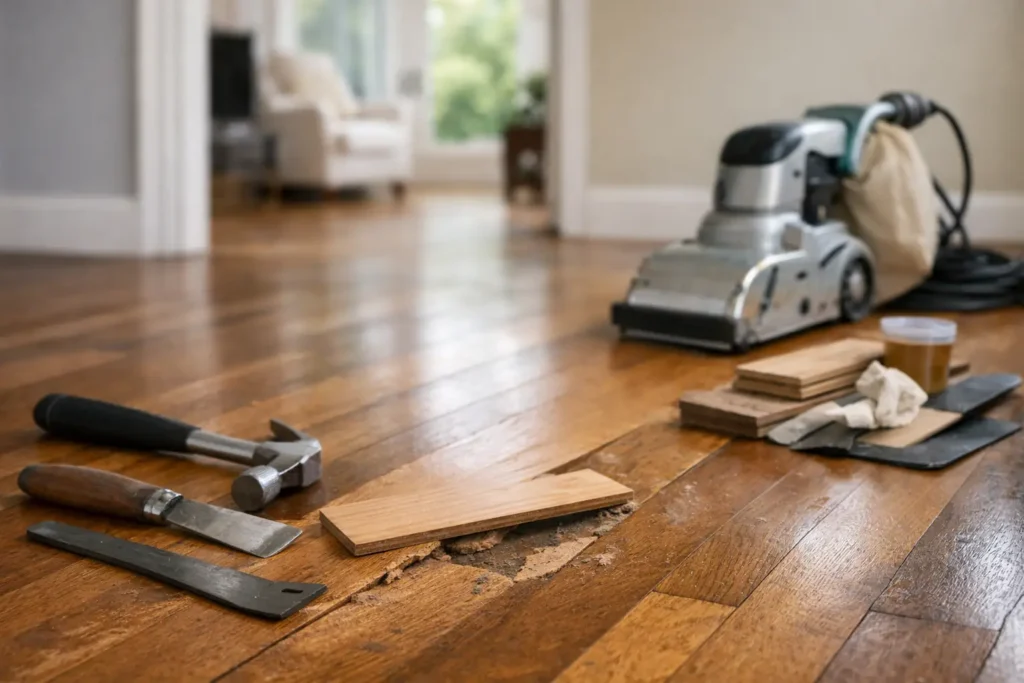
A floor can look tired long before it is truly worn out. In many Connecticut homes, the problem is not that the hardwood has reached the end of its life – it is that years of foot traffic, pet nails, chair movement, moisture, and sun exposure have left it scratched, dull, stained, or uneven in spots. This hardwood floor repair guide Connecticut homeowners can rely on is designed to help you understand what can be fixed, what should be refinished, and when replacement makes more sense.
The good news is that many damaged hardwood floors are repairable. Even better, professional repair does not have to turn your home upside down. With a true dustless sanding system, the floor can be restored with zero dust in the home, which is a major advantage for families with children, pets, or allergy-sensitive households.
What counts as hardwood floor damage
Some problems are cosmetic, while others point to deeper wear in the wood itself. Light surface scratches, faded finish, minor dents, and small dull patches usually fall into the repairable category. These issues often respond well to localized repair, screening, or full refinishing depending on how widespread the wear is.
Deeper gouges, black water stains, cupped boards, loose planks, and soft spots need a closer look. Those can still be repairable, but the method matters. A skilled contractor will determine whether the damaged boards should be replaced individually or whether the entire floor needs sanding and refinishing for a uniform result.
This is where homeowners often save money by getting the diagnosis right the first time. A floor that looks beyond hope may only need board replacement and refinishing. On the other hand, a quick patch on a larger moisture problem usually leads to more repair later.
Hardwood floor repair guide Connecticut homeowners can use by damage type
Scratches and worn finish
If the finish has been scratched but the wood itself is still intact, repair is usually straightforward. In high-traffic areas like hallways, kitchens, and entryways, the protective finish often wears down first. The floor starts to lose its sheen, then picks up visible scuffs and discoloration.
When wear is isolated, spot correction may help. When the finish is failing across the room, sanding and refinishing usually delivers the better long-term result. For Connecticut homeowners, this is especially common after winters filled with tracked-in grit and moisture.
Dents and gouges
Dropped objects, furniture movement, and pet activity can leave dents or deeper marks. Small dents may blend in after refinishing. Deeper gouges sometimes require filling, board repair, or selective plank replacement.
The trade-off is appearance versus cost. A filler can improve the look, but if the damage sits in a highly visible area, replacing the affected board often produces a cleaner finish. An experienced flooring contractor will tell you plainly which option is worth doing.
Water damage and staining
Water is where hardwood repair becomes less predictable. A minor spill cleaned up quickly may only affect the finish. Ongoing moisture from plant pots, appliance leaks, wet boots, or pet accidents can stain the wood and cause boards to cup, separate, or darken.
Black staining usually means moisture has penetrated beyond the surface. Sometimes the repair involves replacing a few boards and blending the surrounding area. Sometimes the floor can be sanded if the stain is shallow enough. The answer depends on the species, the depth of damage, and how long the moisture sat there.
In older Connecticut homes, seasonal humidity swings can also exaggerate movement in the floor. Not every gap or slight crown is a failure. Some movement is normal. Persistent warping or softness is not.
Loose or squeaky boards
A squeak does not always mean the hardwood itself is damaged. It may be caused by movement between the subfloor and the planks, fastener issues, or slight settling in the structure. Repairs can range from securing loose sections to replacing affected boards if wear and movement have weakened them.
This kind of issue benefits from in-person evaluation. What sounds minor underfoot can reveal a bigger structural concern, or it can be a quick repair with minimal floor work.
When repair is enough and when refinishing is smarter
One of the most common homeowner questions is whether to repair a small section or refinish the whole floor. The honest answer is that it depends on the age of the floor, the level of color variation, and how visible the repaired area will be.
If your floor still has a healthy finish and the damage is isolated, targeted repair can make sense. If the surrounding floor is also dull, scratched, or faded, repairing one area alone may leave you with a mismatch. In that case, full dustless sanding and refinishing often gives the best value because it addresses both the damage and the overall appearance at the same time.
That is especially true in open-concept homes, where transitions between repaired and unrepaired areas are harder to hide. A full refinish creates consistency in sheen, color, and texture. It also extends the life of the floor rather than chasing one problem spot at a time.
Why dustless sanding matters during hardwood floor repair
A repair job should improve your home, not make daily life harder. That is why a true dustless process matters so much. At Dustless Hardwood Floors LLC, our proprietary dustless sanding system leaves zero dust in the home. For homeowners in Manchester, West Hartford, Glastonbury, Windsor, and surrounding Connecticut communities, that means a cleaner project experience from start to finish.
This is not just about convenience. Clean, dust-free floor repair is better for families, children, pets, and anyone sensitive to indoor air quality. It also makes the overall project feel more manageable, which is one reason many homeowners move forward with refinishing sooner once they realize they do not have to accept a traditional sanding experience.
The same benefit applies to light commercial spaces and investment properties. If you are preparing a home for sale or updating a rental, clean results and dependable scheduling matter just as much as the finished look.
Signs your floor may need board replacement
Not every damaged plank can be saved. If the wood is split through its depth, severely warped, water-softened, or structurally compromised, replacement is often the right move. The key is replacing only what is necessary and blending the repair into the surrounding floor so it does not stand out.
Wood species, board width, stain color, and age all affect how invisible a repair can be. Older floors sometimes require more skill in matching because the original material may no longer be common. That is where craftsmanship matters. A proper repair should look intentional, not patched.
What Connecticut homeowners should ask before booking repair
Before approving any hardwood floor work, ask whether the contractor is licensed and insured in Connecticut, whether the repair will include color matching if needed, and whether the sanding process is truly dustless. You should also ask how the contractor decides between spot repair, board replacement, and full refinishing.
Clear answers usually signal a professional process. So does transparent pricing. Homeowners should know what is included, what could change based on hidden damage, and what outcome to expect when old wood meets new material.
It also helps to ask about finish options. Some households want the closest possible match to the existing floor. Others use the repair as a chance to refresh the entire room with a new stain color or updated sheen.
A practical repair path for most floors
If you are looking at scratches, water marks, dull traffic lanes, or a few damaged boards, the smartest first step is not guessing. It is having the floor evaluated by a professional who repairs and refinishes hardwood every day. Small issues can often be corrected before they spread. Larger issues can still be very manageable if addressed early.
For many Connecticut homeowners, the best outcome is not replacement. It is restoring the floor they already have – bringing back color, smoothness, and protection with a clean dustless process that leaves zero dust in the home. That combination of repair expertise and dust-free refinishing is what turns a worn floor back into one of the strongest features of the house.
If your hardwood has lost its beauty but still has life left in it, repair may be the step that saves both the floor and the room around it.