
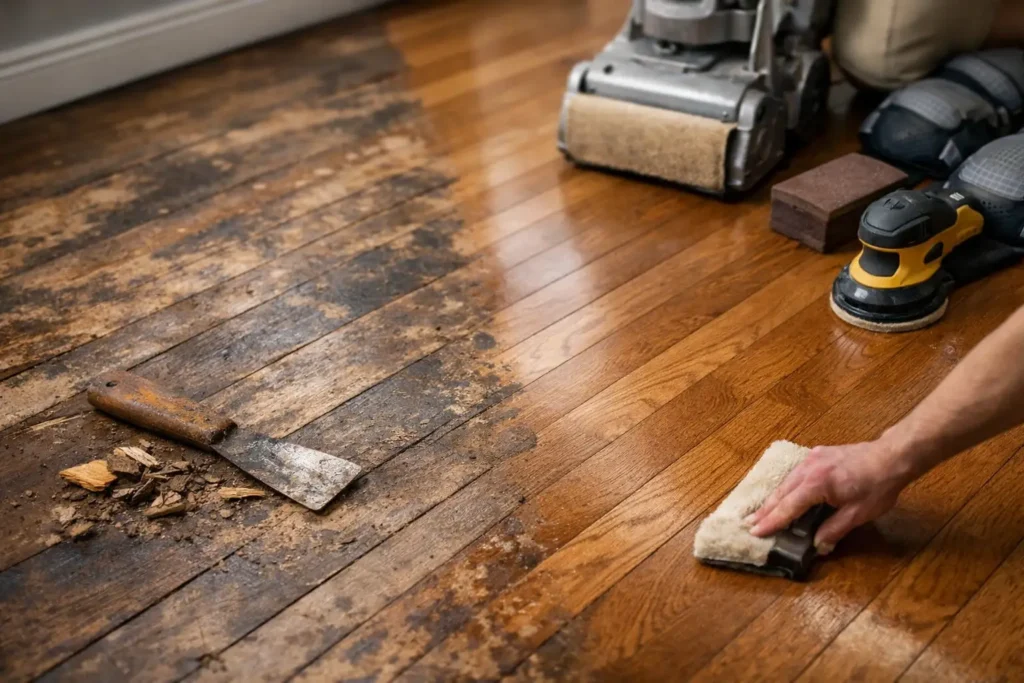
A floor can look finished long before it is actually finished. Homeowners often assume deep scratches, fading, black stains, or worn traffic paths mean replacement is the only option. In many cases, can damaged hardwood be restored is the right question – and the answer is yes, especially when the damage is limited to the finish or the top layer of the wood.
That said, restoration is not a one-size-fits-all decision. Some floors need a full refinish. Some only need targeted repair. And some are too far gone in isolated areas and require board replacement before the floor can be brought back to life. The key is knowing what kind of damage you are looking at and choosing a process that restores the floor without turning your home upside down.
Can damaged hardwood be restored in every case?
Not every damaged floor can be restored in exactly the same way, but many can be saved far more often than homeowners expect. Hardwood is one of the few flooring materials that offers real second chances. Because it is solid wood – or, in some engineered products, a real hardwood wear layer – surface wear, dullness, shallow scratches, and moderate staining can often be corrected through professional sanding, repair, and refinishing.
The biggest factor is depth. If the problem is in the finish, restoration is usually straightforward. If the damage reaches into the wood fibers, the floor may still be restorable, but it may require more involved sanding or selective board replacement. If the boards are structurally unstable from severe rot, repeated flooding, or major cupping and separation, restoration becomes less practical.
That is why a professional evaluation matters. A floor that looks ruined to a homeowner may be an excellent candidate for refinishing. On the other hand, a floor that looks only mildly worn may have hidden moisture issues that should be addressed before cosmetic work begins.
The kinds of hardwood damage that can often be fixed
The most restorable floors are usually the ones with everyday wear. Surface scratches from pets, chairs, and foot traffic are common in busy family homes. Dull finish, uneven sheen, and faded color from sunlight are also strong candidates for refinishing. These issues rarely mean the wood itself is lost.
Water marks are more complicated, but they are not always the end of the road. White haze or light spotting often sits in the finish and can sometimes be corrected with refinishing. Dark stains suggest moisture has penetrated deeper into the wood. Even then, restoration may still be possible through sanding, spot repairs, or replacing a few affected boards.
Dents and gouges fall somewhere in the middle. Minor dents can blend nicely during refinishing. Deeper gouges may need filling or board repair. Gaps, squeaks, and isolated loose boards can also often be repaired as part of a broader restoration plan.
When refinishing is the best answer
If your floor has widespread wear across the room, refinishing is usually the most effective solution. This works especially well when the finish is scratched, cloudy, uneven, or worn down to bare wood in traffic lanes. A full sand and refinish creates a consistent appearance again instead of leaving you with a patchwork of spot fixes.
For Connecticut homeowners, this matters in older homes where original hardwood still has excellent character but no longer looks its best. Refinishing preserves the floor you already have while restoring color, smoothness, and protection.
Just as important, the process should be clean and comfortable for the household. Dustless Hardwood Floors LLC uses a proprietary dustless sanding system that leaves zero dust in the home. That means homeowners can restore beautiful hardwood floors without coating furniture, vents, or living spaces in airborne debris. For families with children, pets, or allergy concerns, that difference is not small – it is often the reason they feel comfortable moving forward with the project at all.
When repair comes before restoration
Some floors need repair before they are ready for sanding and refinishing. A few damaged boards near a doorway, sink, or entry area do not automatically mean replacing the entire floor. In many cases, those individual sections can be removed and replaced so the rest of the floor can be restored.
This is common after isolated How to repair water damage, heavy impact, or pet-related wear in one part of the room. The goal is to save as much of the original floor as possible while making the final result look intentional and cohesive.
Color matching is part of that process, but expectations should be realistic. Wood is a natural material, and new boards may take stain differently than older boards with years of aging and sun exposure. A skilled refinishing approach helps blend those differences, but the extent of the match depends on species, age, and condition.
Signs your hardwood may be beyond simple restoration
There are cases where restoration is limited or partial. If boards are warped from long-term moisture exposure, cracked through their thickness, or softened by rot, refinishing alone will not solve the problem. The same is true if the floor has been sanded too many times already and there is not enough wear layer left to refinish safely.
Engineered hardwood deserves special mention here. Some engineered floors can be restored, but only if the top hardwood layer is thick enough. Others are too thin for full sanding. This is one reason professional inspection matters before any promises are made.
You should also be cautious with black staining that covers large areas, persistent buckling, or recurring moisture damage. In those situations, the floor problem may really be a water problem. Fixing the appearance without fixing the source will only lead to repeat damage.
Why professional restoration usually outperforms DIY fixes
Many store-bought products promise to hide scratches or revive tired wood. Some can improve appearance for a short time, especially on minor surface wear. But they rarely solve uneven finish, deeper staining, or widespread damage. In some cases, they create buildup that makes future refinishing more difficult.
Professional restoration is different because it addresses the actual condition of the floor, not just the symptom. The finish is properly removed, repairs are handled where needed, and a new protective surface is applied evenly across the room.
There is also the issue of indoor comfort. Traditional sanding has made many homeowners delay needed work because they worry about their home environment during the project. A dustless system changes that experience. With zero dust left in the home, the process is cleaner, healthier, and much easier to live with – especially in occupied homes where daily routines still matter.
What homeowners should expect from the restoration process
A good restoration project starts with an honest assessment. The contractor should identify whether the floor needs screening, sanding, repairs, staining, board replacement, or a combination of services. The right recommendation depends on the age of the floor, the wood species, the depth of wear, and whether moisture damage is active or old.
From there, the value is in clarity. Homeowners should know what can be restored, what cannot be fully hidden, how color choices may affect the final result, and what timeline to expect. Straight answers matter, especially for investment properties, pre-sale updates, and busy households that need reliable scheduling.
For many homes in Manchester, West Hartford, Glastonbury, and surrounding Connecticut communities, restoration is the smarter move than replacement. It preserves original materials, improves the look of the entire space, and often adds immediate visual value.
How to tell if now is the right time
If your floors look tired every time the light hits them, now is probably the right time to have them evaluated. Waiting is not always harmless. Scratches that cut through the finish leave wood exposed. Worn areas near kitchens, hallways, and entry points are more vulnerable to moisture and staining the longer they sit unprotected.
The earlier damage is addressed, the more options you usually have. A floor that can be fully restored today may need partial replacement later if wear continues unchecked.
And if one of the reasons you have postponed the project is concern about your home staying clean and comfortable, that is worth revisiting. Modern dustless sanding makes professional restoration far easier for families who want beautiful results without the stress they may associate with older refinishing methods.
Hardwood floors do not need to be perfect to be worth saving. In many homes, they simply need the right repairs, a careful refinish, and a contractor who can restore them cleanly. When the work is done well, the floor does not just look better – the whole room feels cared for again.