
Choosing flooring sounds simple until you are standing between two samples that both look good and promise long-term value. When homeowners ask about prefinished vs site finished hardwood, they are usually trying to answer a more practical question: which floor will look better, hold up longer, and fit real life in a busy Connecticut home?
The answer depends on the room, the condition of the subfloor, the style you want, and how much customization matters to you. It also depends on whether you are installing new hardwood or trying to restore what you already have. For many homeowners, that second question matters just as much, especially when existing floors can often be transformed with professional dustless sanding and refinishing that leaves zero dust in the home.
Prefinished vs Site Finished Hardwood: What is the difference?
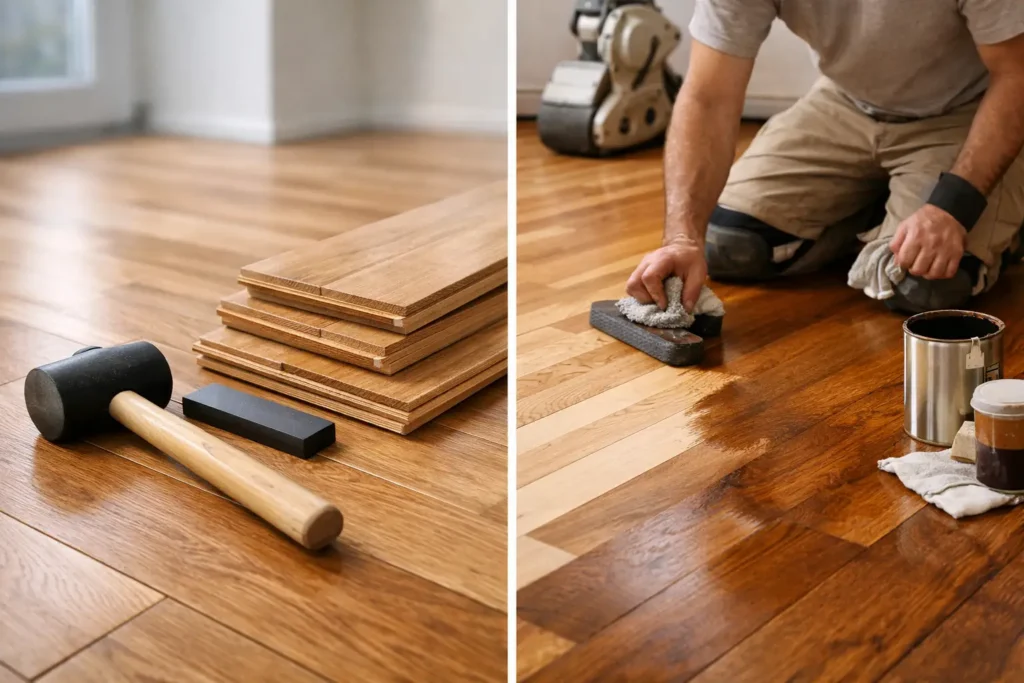
Prefinished hardwood is factory-finished before it arrives at your house. The boards are stained and sealed in a controlled manufacturing setting, then installed with the finish already in place. Once installation is complete, the floor is largely ready for use.
Site finished hardwood is installed first and then sanded, stained, and sealed inside the home. This approach gives you more control over the final color, sheen, and overall appearance because the whole floor is finished as one continuous surface.
At a glance, prefinished flooring often wins on speed. Site finished flooring usually wins on customization and a more seamless look. But that is only the surface-level comparison.
How the finished look compares
If appearance is your top priority, site finished hardwood has a strong advantage. Because the floor is sanded and coated after installation, the boards blend together more smoothly. You do not have the slight bevels commonly found on many prefinished planks, so the result feels more unified and custom.
That matters in older Connecticut homes, where character is part of the appeal. If you want a classic, elegant floor that looks tailored to the room instead of selected from a carton, site finishing often delivers that result better.
Prefinished hardwood can still look beautiful. It comes in a wide range of wood species, stains, widths, and textures, and many products are designed to match current design trends. If you know exactly what you want and can find it in a prefinished line, it can be an efficient option. Still, you are choosing from a manufacturer’s menu rather than creating a finish specifically for your home.
Why bevels matter more than people expect
Many prefinished floors have micro-beveled edges. Some homeowners like that definition because it highlights each plank. Others feel it interrupts the visual flow, especially in open-concept spaces or formal rooms.
Site finished floors usually have a flatter, more continuous surface. That can make the room feel cleaner and more refined. It is a small detail, but it changes the overall impression of the floor.
Durability is not a one-size-fits-all answer
A lot of homeowners assume prefinished hardwood is always tougher because factory finishes are cured under tightly controlled conditions. In many cases, prefinished products do have very durable wear layers. For households with kids, pets, and constant foot traffic, that can be appealing.
But durability is not just about the initial finish. It is also about how the floor performs over time and how easily it can be corrected when wear shows up. Scratches, dull traffic lanes, minor water marks, and finish breakdown are part of real life. That is where site finished floors can become the more practical long-term choice, especially if they can be professionally renewed instead of replaced.
For existing hardwood, refinishing is often the better investment than tearing everything out. With a dustless sanding system that leaves zero dust in the home, homeowners can restore worn floors without turning the house upside down. That clean process is especially valuable for families, pet owners, and allergy-sensitive households who want beautiful results without sacrificing indoor comfort.
Cost: upfront price vs long-term value
If you are comparing prefinished vs site finished hardwood strictly on initial project cost, prefinished sometimes appears easier to budget because labor on the finishing side is reduced. Installation moves faster, and there are fewer steps after the boards are down.
Site finished hardwood can cost more upfront because it includes sanding, staining if desired, and multiple coats of finish. However, the value conversation should not stop there. A better fit for the room, a more custom look, and easier visual continuity can make that added cost worthwhile.
The same logic applies when homeowners debate replacement versus refinishing. If your current hardwood is structurally sound, refinishing can deliver a dramatic upgrade for less than full replacement. In many Connecticut homes, original hardwood has more potential than people realize.
Best use cases for prefinished hardwood
Prefinished flooring tends to make sense when speed matters and the product you want is available off the shelf. It is often a strong fit for investment properties, straightforward room additions, or homes where the existing flooring has already been removed and a quick installation timeline is a priority.
It can also be a good option when you want a specific wood width, texture, or factory color and do not need custom stain matching. For some property owners, predictability is the biggest advantage. You can see the finished board before installation begins, which removes some of the guesswork.
That said, subfloor flatness and board alignment become especially important with prefinished products because the final surface is not sanded after installation. Any minor height differences between boards may remain more noticeable.
When site finished hardwood is the better choice
Site finished hardwood is often the better fit when the goal is a high-end, built-for-the-home appearance. It works well in living rooms, dining rooms, stair landings, and whole-home projects where continuity matters.
It is also the clear choice when you are blending new wood into existing hardwood. Matching older floors takes skill, and site finishing allows a contractor to sand and finish the surfaces together for a more cohesive result.
For repair work, site finishing is especially valuable. If sections of the floor are patched due to damage, refinishing the area – or the whole floor when needed – can help the repair disappear visually. That is hard to achieve when you are limited to prefinished boards with a fixed color and sheen.
Existing floors deserve a close look first
Many homeowners assume they need all-new flooring because their hardwood looks tired. But worn does not mean finished. Surface scratches, dullness, fading, pet wear, and many signs of age can often be corrected through refinishing.
This is where a professional evaluation matters. A licensed and insured hardwood flooring contractor can tell you whether your floor needs repair, refinishing, partial replacement, or a full new installation. In many cases, the smartest choice is to preserve the hardwood you already have and bring it back to life with dustless sanding and refinishing.
What Connecticut homeowners should weigh most
In older homes around Manchester, West Hartford, Glastonbury, and nearby communities, no two flooring projects are exactly alike. Seasonal humidity changes, previous renovations, and existing floor condition all affect the right decision.
If your home has original hardwood with good bones, refinishing often gives you the strongest return because you keep the character of the home while improving the appearance and protection of the floor. If you are building out a new room or replacing damaged material beyond repair, then the prefinished versus site finished decision becomes more relevant.
Either way, clean execution matters. Homeowners are not just choosing a floor. They are choosing what the process feels like inside their home. A dustless sanding system that leaves zero dust in the home changes that experience completely. It allows families to improve their floors in a cleaner, more comfortable way, which is exactly what many Connecticut households want.
So which one should you choose?
Choose prefinished hardwood if you want a faster installation, a factory-applied finish, and a product whose final appearance is selected in advance. Choose site finished hardwood if you want more control over color, a smoother and more custom appearance, and better flexibility for matching, repairs, or whole-home continuity.
If you already have hardwood floors, do not skip the possibility of refinishing before you commit to replacement. That option is often the most cost-effective path to a floor that looks dramatically better, especially when the work is done with a zero-dust dustless sanding process.
The best flooring decision is rarely about what is trending. It is about what fits your home, your goals, and the way you want the finished space to feel every day.