
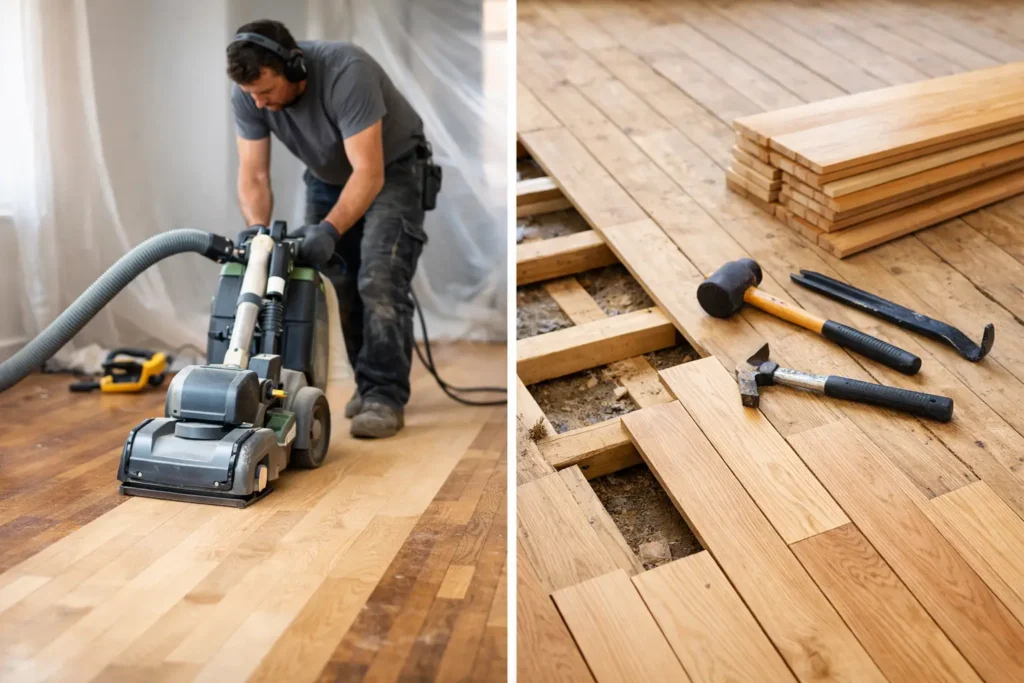
When your hardwood floors look tired, the big question usually comes down to dustless sanding vs floor replacement. For many Connecticut homeowners, the right answer is not starting over – it is restoring the wood you already have with a true dustless sanding system that leaves zero dust in the home. That means you can bring back the beauty of your floors without turning your house upside down.
The decision matters because refinishing and replacing are not interchangeable. One preserves what is already there. The other removes it and installs something new. Both have a place, but the better option depends on the condition of the floor, your budget, your timeline, and how much change you actually want.
Dustless sanding vs floor replacement: what changes most?
At a glance, both options improve appearance. That is where the similarity ends.
Dustless sanding and refinishing keeps your existing hardwood in place. The floor is sanded, repaired as needed, stained if desired, and sealed with a fresh finish. If the boards are structurally sound, this approach can make older hardwood look dramatically newer while preserving the character of the home.
Floor replacement is a bigger reset. Old flooring is removed, the subfloor may need work, and new hardwood or another flooring product is installed. This is usually the right path when the existing floor cannot be saved or when the homeowner wants a completely different material, board width, or layout.
For homeowners who like the natural look of their current hardwood and simply want it restored, replacement is often more than they need. For floors with severe structural damage, replacement may be the only realistic choice.
When dustless sanding is the smarter investment
Most worn hardwood floors do not need to be replaced. They need professional refinishing.
Surface scratches, dull finish, light pet wear, faded color, minor dents, and many signs of everyday aging are usually cosmetic. In those cases, dustless sanding gives you the biggest visual improvement for the lowest level of upheaval. You keep the original wood, improve the finish, and often spend far less than full replacement.
This is especially important in older Connecticut homes where existing hardwood often has better material quality than many newer flooring products. Solid wood floors were made to be renewed. If the boards still have life left in them, replacing them too early can mean giving up character and durability you cannot easily duplicate.
There is also the comfort factor. Homeowners with children, pets, or allergy concerns often want a cleaner process from start to finish. That is where the method matters as much as the result. Our proprietary dustless sanding system leaves zero dust in the home, which is a major advantage for families who want beautiful floors without compromising indoor comfort.
When floor replacement makes more sense
Refinishing is powerful, but it is not magic. Some floors truly are beyond the point where sanding is the best use of your money.
Replacement is usually worth considering when boards are badly warped, rotted, deeply water-damaged, broken in multiple areas, or previously sanded down too many times. It can also make sense if large sections of the floor are missing, patched with mismatched materials, or no longer stable underfoot.
Design goals can also push the decision toward replacement. If you want to switch from narrow strip flooring to wide planks, change species entirely, or install hardwood in rooms that currently have another material, replacement opens up those possibilities.
Even then, the answer is not always all or nothing. In many homes, selective board repair combined with dustless sanding and refinishing gives homeowners the look they want without the cost of tearing everything out.
Cost: refinishing usually wins, but not always
For most homeowners, budget is one of the first filters. In a straightforward comparison, refinishing existing hardwood is typically more affordable than replacing it. You are not paying for full demolition, disposal, new flooring material, and complete installation labor.
That said, very damaged floors can shift the math. If repairs become extensive enough, or if the floor has hidden structural issues, replacement may become more practical long term. The key is getting an honest assessment before spending money in the wrong direction.
A trustworthy contractor should explain whether your current floor is a strong candidate for refinishing, whether repairs are likely to hold up, and whether replacement would actually solve a deeper problem. That kind of guidance helps you avoid paying for a short-term fix when you really need a full reset, or overpaying for replacement when refinishing would have delivered the same visual impact.
Appearance: restored character vs brand-new look
This is where personal preference comes in.
Dustless sanding and refinishing is ideal if you love the look of real hardwood and want to bring back its natural warmth. You can often remove years of wear, adjust the stain color, improve sheen, and make the floor feel current again without losing the original charm of the home.
Replacement gives you more creative freedom. You can change species, plank width, grade, and overall style. If your goal is a totally different floor, replacement has the edge.
But many homeowners are surprised by how dramatic refinishing can be. A floor that looks dated, scratched, or uneven can look refreshed and high-end once the old finish is removed and the wood is properly restored. If your hesitation is based on how the floor looks today, it is worth remembering that current appearance does not always reflect what the wood can become.
Timeline and disruption
Homeowners often assume replacement is the cleaner or simpler path because it feels more decisive. In practice, it is usually a larger project with more moving parts.
Replacement involves removal, disposal, material delivery, installation, and finishing depending on the product. If subfloor repairs are needed, the schedule can stretch further.
Dustless sanding and refinishing is often more efficient because the existing floor stays in place. You are improving what is already there instead of rebuilding from scratch. For busy households and occupied properties, that can be a major benefit.
Just as important, the right refinishing process should support a clean, comfortable home environment. Dustless Hardwood Floors LLC specializes in dustless hardwood floor sanding that leaves zero dust in the home, making the process safer and easier for families, children, pets, and allergy-sensitive households.
Dustless sanding vs floor replacement for Connecticut homes
Connecticut homes bring their own set of considerations. Many properties in areas like West Hartford, Manchester, Glastonbury, and surrounding Hartford County neighborhoods have solid hardwood floors with real age and character. In those homes, refinishing often protects an asset that adds long-term value.
Seasonal humidity changes also matter. A professional evaluation can tell you whether gaps, cupping, or movement are finish-related, moisture-related, or signs of deeper failure. Homeowners sometimes assume visible wear means the floor has reached the end of its life, when the real issue is simply that the finish is worn out.
That is why a local, licensed, and insured hardwood flooring contractor matters. You want someone who understands how New England homes behave and can tell the difference between a floor that needs restoration and one that truly needs replacement.
How to decide without guessing
The best decision usually comes down to three questions.
First, is the wood structurally sound? If yes, refinishing deserves serious consideration. Second, do you want to preserve the current hardwood or change the floor completely? Third, are you trying to solve cosmetic wear or major material failure?
If the issues are mostly on the surface, dustless sanding is often the clear winner. If the floor is compromised at its core, replacement may be the better investment.
A professional site evaluation should look at board thickness, previous sanding history, water damage, loose sections, deep gouges, stains, and repair options. That is the kind of real-world inspection that gives homeowners clarity instead of a sales pitch.
The better question is not which is bigger – it is which is right
Home improvement decisions often get framed as bigger equals better. With hardwood floors, that mindset can cost you money. The smartest move is the one that restores beauty, protects value, and fits your home without unnecessary expense.
If your hardwood floors are worn but still solid, dustless sanding and refinishing is often the more practical, more cost-effective, and more family-friendly path. You keep the wood, renew the finish, and enjoy clean results with zero dust in the home. If your floors are structurally failing or your design goals require a complete change, replacement may be the right call.
The good news is that you do not have to guess. A clear professional assessment can tell you what your floors are capable of – and sometimes the best-looking result starts with keeping what you already have.