
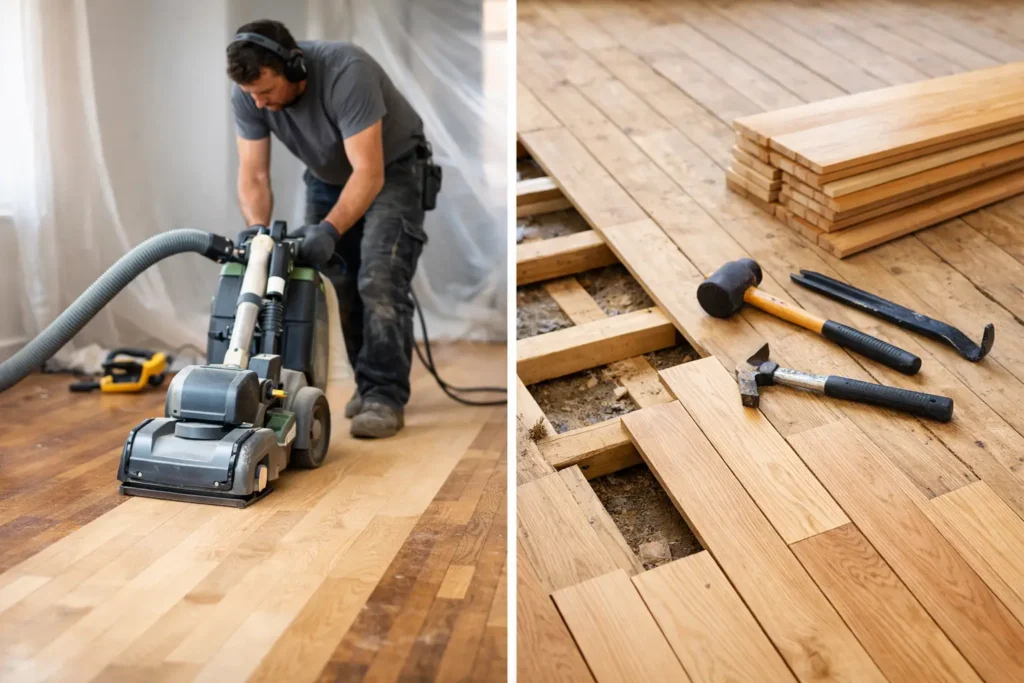
Hardwood Floor Refinishing vs. Replacement: The Definitive Guide for Homeowners
If you have hardwood floors in your home, you have probably noticed the signs of daily wear and tear: surface scratches, dull spots, traffic paths, or areas that just do not look the way they used to. At some point, almost every homeowner stops and asks the same critical question: Can these floors be fixed with a dustless sanding and refinishing, or do they need to be completely replaced?
This is not a small decision. Hardwood floors are a major investment in your property’s equity. The thought of spending your hard-earned money, dealing with noise, and potentially making the wrong structural choice can feel overwhelming. Many homeowners worry about making a costly mistake or choosing a temporary patch that will not last.
This guide is here to make things simple. We will explain both options in clear, straightforward language. You will learn how to accurately check the physical condition of your floors, understand exactly what modern dustless refinishing can and cannot fix, and know precisely when a full replacement is the safer, more stable choice for your home.
Understanding Hardwood Floor Refinishing
Hardwood floor refinishing is the first option to consider when your floors look tired and worn out but still feel structurally solid underfoot. This process focuses on restoring the beautiful wood asset you already have rather than throwing it away and starting over from scratch. When executed at the right time by an experienced professional, refinishing makes decades-old floors look brand new.
What Refinishing Involves
Refinishing is a precise, step-by-step process where each stage plays an important role in how your floors look and how long your new protective finish will last.
- Sanding: This is the most critical stage. Professionals utilize specialized heavy machinery to sand away the old, yellowed finish and remove a micro-thin layer of the raw wood surface. This completely eliminates light scratches, pet stains, scuffs, and minor dents, leaving a perfectly smooth, raw wood canvas.
- Staining (Optional): Once the wood is sanded raw, you can choose to change the color completely. You can keep the natural wood tone or go with a modern lighter gray, a deep dark espresso, or a classic warm brown to match your updated interior design.
- Sealing and Finishing: Finally, several coats of high-grade commercial finish are applied. This acts as a clear shield that protects the raw wood from daily traffic, liquid spills, pet claws, and moisture. You can choose a matte, satin, semi-gloss, or glossy sheen depending on your taste.
Key Benefits of Refinishing
For the vast majority of Connecticut homeowners, professional refinishing offers the most rewarding, high-value solution.
- Substantially Lower Cost: Refinishing generally costs a fraction of the price of a full replacement. You are maximizing the value of what is already there instead of paying for massive piles of new lumber and extensive labor.
- Preserves Historic Character: Older homes often feature old-growth hardwood with tight grain patterns, rich character, and historical charm that is impossible to buy in modern lumber yards today. Refinishing brings that original beauty back to life.
- Extends Lifespan: A properly executed refinish adds decades of useful life back into your floors. It refreshes the worn-out surface layer and locks down a durable barrier that protects the wood from future damage.
- Creates Less Waste: Because your existing floorboards stay firmly nailed in place, refinishing generates very little construction waste. This makes it an incredibly environmentally friendly, sustainable home improvement choice.
Limitations and Drawbacks of Refinishing
While refinishing works miracles in most homes, it does have a few limitations to keep in mind.
- Temporary Disruption: Your furniture must be completely cleared out of the working areas, and those specific rooms will be off-limits during the sanding and curing process.
- Sanding Thickness Limits: Hardwood can only be sanded a limited number of times. If a floor has been aggressively sanded down by previous owners, there may not be enough wood thickness left above the tongue-and-groove joint to sand it safely again.
- Deep Structural Damage: Refinishing only addresses surface aesthetics. If your wood has deep, widespread structural rot, heavy water warping, or deep pet urine stains that have soaked completely through the board to the subfloor, sanding will not fix it.
Expert Guidance and Industry Standards
Professional floor refinishing follows established engineering best practices. Reputable contractors align their on-site methods with the strict structural recommendations of the National Wood Flooring Association (NWFA). These industry guidelines ensure that your floors are measured for moisture, sanded safely with proper grit sequences, and sealed with commercial-grade finishes to guarantee long-term performance.
Following recognized industry standards takes the guesswork out of floor restoration, ensuring a predictable, flawless finish that protects your home’s value.
Understanding Hardwood Floor Replacement
Hardwood floor replacement is the necessary solution when the existing wood has reached the absolute end of its physical lifespan or when refinishing is no longer structurally practical. While it requires a significantly larger financial investment and demolition timeline, it is sometimes the only safe way to solve hidden moisture issues and protect your property over the long term.
What Replacement Involves
Replacing a hardwood floor means completely tearing out your old flooring material and constructing a brand-new floor system from the subfloor up.
- Removal of Old Flooring: The old, damaged hardwood is pried up, cut out, and hauled away. This demolition stage is noisy and messy, especially in historic homes where flooring was fastened down with heavy structural nails.
- Subfloor Inspection and Repair: Once the old wood is removed, the exposed subfloor is carefully inspected for soft spots, structural sags, mold, or rot. The subfloor must be made completely flat, structurally solid, and dry before any new wood can be installed.
- Installation of New Wood: Brand-new hardwood boards are laid down, aligned, and securely fastened down. If you choose unfinished solid wood, it will be sanded and finished on-site. If you choose prefinished hardwood, it arrives pre-stained and sealed from the factory, which allows for faster clean up.
Key Benefits of Replacement
Replacement makes the most sense when a homeowner wants a clean slate with zero structural or design compromises.
- An Absolute Fresh Start: Replacement allows you to completely alter the visual look and feel of your home. You can switch to an entirely different wood species (like shifting from Red Oak to White Oak), upgrade to modern ultra-wide planks, or change the structural layout direction of the boards.
- Fixes Structural and Hidden Problems: Tearing up the old floor boards gives you 100% access to your home’s underlying subfloor structure. This makes it easy to replace rotting plywood, reinforce bouncy floor joists, and permanently stop annoying squeaks that refinishing can never fix.
- No Future Sanding Restrictions: Installing brand-new, full-thickness solid hardwood resets the clock entirely. Your new floors will have their full wear layer intact, meaning they can be safely refinished multiple times by future generations.
Limitations and Drawbacks of Replacement
- Higher Upfront Investment: Replacing a floor costs significantly more per square foot than refinishing. You have to pay for the raw lumber materials, demolition labor, disposal fees, subfloor prep, and new installation labor.
- Major Household Disruption: Floor replacement is an extensive construction project. Entire sections of your home will be completely unusable for weeks at a time. The demolition process creates heavy noise and vibrations throughout the structure.
- Greater Environmental Waste: Tearing out old floors generates a massive volume of construction debris that inevitably ends up in local landfills. It also requires the harvesting and transportation of brand-new natural timber resources.
Key Factors to Consider Before Deciding
Before choosing between refinishing or replacement, it helps to slow down and audit your specific project against these critical real-world factors.
1. Floor Condition: The Ultimate Decider
The physical state of your floorboards will usually make the decision for you.
- Surface vs. Deep Scratches: Light surface scratches, dog nail scuffs, and faded walkways are easily erased with a standard dustless sand and finish. Deep structural cracks or jagged gouges require board replacements.
- Moisture and Water Damage: Look closely for severe “cupping” (where the edges of the boards curl upward) or “buckling” (where the floor sections lift completely off the subfloor). Small, localized water stains can be sanded out, but widespread moisture damage requires a total replacement and moisture source correction.
- Structural Integrity: If your floor has loose, bouncy boards, deep soft spots, or severe creaking when walked on, the issue is likely a failing subfloor underneath. Refinishing will not fix these hidden mechanical problems.
2. Budget and Return on Investment (ROI)
Cost matters, but so does long-term value.
- Upfront Cost Savings: Refinishing is the clear winner for budget efficiency, allowing you to beautifully restore your home’s appearance while keeping your cash available for other investments.
- Long-Term Equity: If your floorboards are thick and healthy, refinishing offers an incredible return on investment, especially if you plan to sell your home soon. Full replacement should be reserved for instances where the current floor is completely unsalvageable or completely out of style for a luxury market.
3. Time Commitment and Disruption
Think realistically about how much construction disruption your family lifestyle can handle.
- Refinishing Timeline: A standard dustless refinishing project is fast, typically taking anywhere from 3 to 7 days depending on the square footage and the drying time required between finish coats.
- Replacement Timeline: A complete tear-out and replacement is a multi-stage construction project that can easily stretch from 1 to 3 weeks once subfloor modifications and material acclimation times are factored in.
The Ultimate Comparison at a Glance
| Attribute | Hardwood Floor Refinishing | Hardwood Floor Replacement |
|---|---|---|
| Average Cost | Lower. Extremely cost-effective per square foot. | Higher. Requires material purchase + demolition + installation. |
| Core Process | Dustless sanding, optional staining, and commercial sealing. | Total demolition, subfloor correction, and brand-new layout installation. |
| Timeframe | Fast turnaround (Typically 3 to 7 days). | Extended construction (Typically 1 to 3 weeks). |
| Household Disruption | Moderate. Rooms must be cleared of furniture for a short period. | High. Heavy demolition noise, structural dust, and construction traffic. |
| Aesthetic Result | Restores original beauty; color can be fully customized. | Complete transformation (New wood species, widths, and patterns). |
| Durability Lifespan | Adds 10 to 15+ years of fresh protection to your existing wood. | Resets the clock completely for the full lifespan of a brand-new floor. |
| Environmental Impact | Eco-Friendly. Reuses existing materials and minimizes landfill waste. | Higher. Generates demolition waste and consumes new timber resources. |
Expert Tip: Control Interior Humidity First
No matter which option you choose for your home, indoor climate control is paramount. Real hardwood floors perform best when your home’s relative humidity stays consistently between 35% and 55% year-round.
Excessive moisture causes wood boards to expand, leading to cupping, while extreme winter dryness causes wood to shrink, creating wide, unsightly gaps between the planks. Before investing thousands of dollars into refinishing or replacement, ensure your home’s HVAC system, humidifiers, or basements are properly regulated to protect your flooring investment for decades to come.
Need an Expert Opinion on Your Connecticut Floors?
Making the right choice between refinishing and replacement requires an experienced eye. If you want to know for certain whether your existing hardwood floors can be saved with an advanced, 99.8% dustless sanding and refinishing, let a professional diagnose them in person.
Get a free, transparent, in-home estimate today. Contact Dustless Hardwood Floors LLC directly at (860) 993-7657 to schedule your consultation. We proudly serve homeowners across Manchester, West Hartford, Glastonbury, and throughout the Greater Hartford area, delivering pristine, museum-quality floors without the mess.