
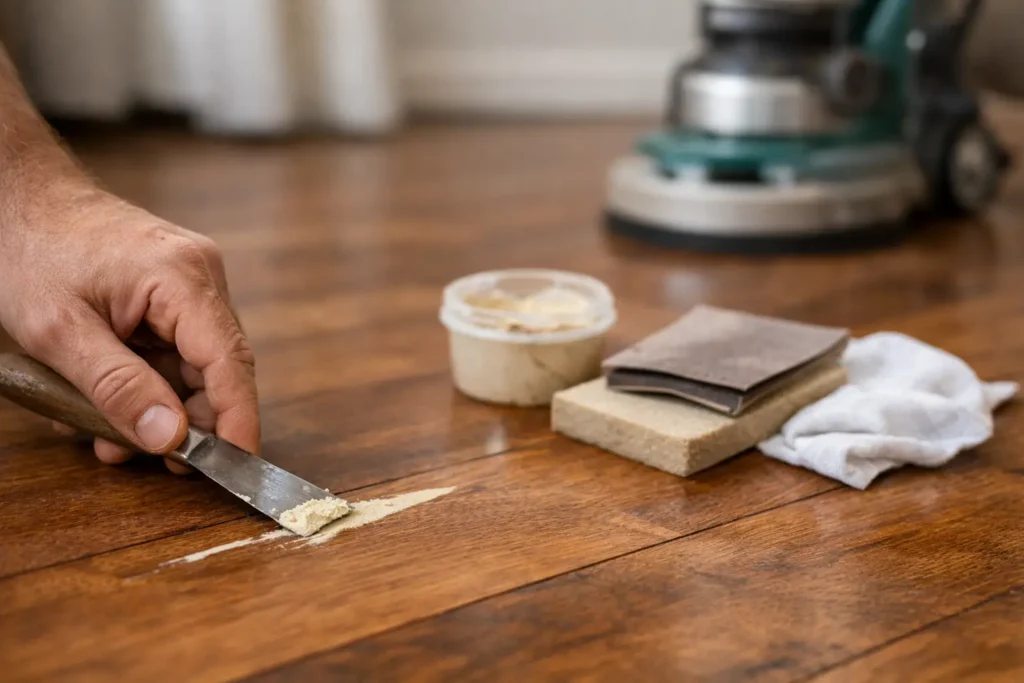
A deep gouge in a hardwood floor changes the whole room. Even when the rest of the floor only looks worn or dull, one carved-out mark can make the surface look neglected. That is why hardwood floor gouge repair before refinishing matters so much. If the damage is handled correctly before sanding and coating, the finished floor looks smooth, consistent, and properly restored instead of freshly coated with old problems still showing.
For Connecticut homeowners, the real question is not whether the gouge should be repaired. It is how far the repair should go before refinishing begins. Some gouges can be filled and blended beautifully. Others need a board replacement, especially when fibers are crushed deeply or the damage runs across a high-traffic area where a patch would remain obvious after stain and finish are applied.
Why hardwood floor gouge repair before refinishing matters
Refinishing improves color, sheen, and surface wear, but it does not erase missing wood. Sanding can flatten shallow scratches and minor dents, yet a true gouge is different. A gouge removes material below the normal sanding depth, which means the defect will still be there unless it is repaired first.
This is where many homeowners get tripped up. From a distance, a gouge can seem like something that will disappear once the floor is sanded and coated. In practice, finish tends to highlight low spots, rough edges, and filler mismatches if the repair was rushed. The goal is not simply to make the hole less visible. The goal is to make the floor look intentional and uniform once the refinishing is complete.
That also affects durability. If damaged areas are left weak, the new finish sits over unstable wood. Over time, those spots can wear unevenly, collect dirt, or draw attention every time light hits the floor at an angle.
What counts as a gouge and what does not
Not every mark needs the same treatment. A surface scratch usually affects the finish and maybe the top fibers of the wood. A dent compresses wood downward without fully tearing it away. A gouge cuts into the board and removes material, leaving a trough, chip, or ragged cavity.
That distinction matters because repair options depend on depth, width, and location. A small isolated gouge near a wall may be a simple filler repair before sanding. A long, deep gouge in the middle of a dining room, especially on stained oak where color variation is noticeable, may call for a more exact approach.
Wood species matters too. Red oak, white oak, maple, and older mixed hardwood floors all accept stain and filler a little differently. That is why one-size-fits-all advice from a hardware store often leads to repairs that stand out after refinishing.
When filling a gouge is the right choice
Filling is often the best solution when the gouge is localized, the surrounding board is stable, and the damaged area is not so large that it interrupts the grain pattern across the room. In those cases, a professional can clean out loose fibers, shape the repair area if needed, apply the right wood filler or repair compound, then sand and blend the area into the surrounding floor.
The phrase hardwood floor gouge repair before refinishing often brings to mind filler alone, but the real skill is in matching the floor after sanding and stain selection. Some repairs look acceptable in raw wood but become more visible after stain. Others disappear nicely with a natural finish but would be harder to hide on very dark stained floors.
This is where experience matters more than product labels. A repair has to be judged not by how it looks halfway through the process, but by how it will look after the final coat cures.
When a board should be replaced instead
There are times when filling is simply not the best answer. If the gouge is deep enough that the board has lost structural integrity, if the edges are splintered badly, or if the damage covers a broad section of one plank, replacement usually gives a cleaner result.
Board replacement is also worth considering when the gouge sits in a highly visible area such as an entry, hallway centerline, or open living space with strong natural light. Those are the locations where even a decent filler repair may still catch the eye. Replacing the damaged board before refinishing can produce a far more natural appearance.
There is a trade-off, though. Replacement requires careful fitting, species matching, and blending with surrounding boards. In older homes throughout Hartford County and nearby Connecticut communities, existing floors may have aged in color over decades. A newly inserted board has to be selected and finished with that reality in mind. The answer is not always replacement just because the gouge looks severe at first glance.
Why DIY gouge repair often looks fine at first and worse later
Many store-bought patch kits promise a quick fix. For minor cosmetic issues, they can help. But before a full refinishing project, DIY gouge repair can create more work if the material is too soft, shrinks, rejects stain, or leaves a flat spot that does not follow the surrounding board texture.
Another common problem is overfilling. Homeowners understandably want to level the damaged spot completely, but if the patch sits proud of the wood or smears into the grain, sanding can expose an even bigger visual difference. Color matching is another challenge. Wood changes tone under finish, and repairs that looked close enough before coating can turn noticeably off once the floor is sealed.
That does not mean every small gouge requires a full restoration crew. It means that if refinishing is already planned, repairs should be evaluated as part of the whole floor system, not as a separate cosmetic patch.
The advantage of professional repair before dustless refinishing
The cleanest results come from treating gouge repair and refinishing as one coordinated project. A professional first determines whether the damage should be filled, rebuilt, or replaced. Then the floor is prepared, sanded, and refinished so the repaired area blends into the overall surface rather than looking like a last-minute patch.
For families, pet owners, and allergy-sensitive households, the process matters just as much as the appearance. Dustless Hardwood Floors LLC uses a proprietary dustless sanding system that leaves zero dust in the home. That means homeowners can restore heavily worn or gouged floors without the airborne residue people worry about with older sanding methods. It is a cleaner, safer option for children, pets, and anyone who wants a beautiful result without turning the house upside down.
That benefit becomes especially valuable when repairs are more involved. If a floor has multiple gouges, old filler failures, or a combination of dents and finish wear, having everything addressed within a zero-dust sanding process keeps the project far more comfortable from start to finish.
What to expect during hardwood floor gouge repair before refinishing
The first step is inspection. The damaged area needs to be assessed for depth, board movement, moisture exposure, and visibility within the room. A gouge caused by dragged furniture is usually straightforward. Damage tied to water, pet wear, or repeated impact may involve more than the surface.
Next comes repair planning. Some rooms need only isolated filling before sanding. Others benefit from replacing one or two boards so the final finish looks more natural. Stain choice may also influence the plan because lighter and darker finishes reveal repairs differently.
Then the floor is sanded and refinished as a whole surface. This is what creates consistency. Rather than leaving repaired spots with a different texture or sheen, the entire floor is brought back to a uniform appearance. With a true dustless sanding system, that transformation happens with zero dust in the home, which is a major advantage for occupied homes across Connecticut.
How homeowners can tell it is time to repair now, not later
If you can catch your sock on the damaged spot, see raw wood clearly below the surrounding surface, or notice multiple deep marks that sanding alone will not remove, now is the time to address them. Waiting usually does not improve anything. In fact, exposed wood can darken, fray further, or absorb moisture and dirt, which makes blending more difficult later.
The same is true if you are preparing a home for sale or updating a rental property. Buyers and tenants notice floor damage quickly. A properly repaired and refinished hardwood floor adds polish to the entire space, while visible gouges suggest deferred maintenance even if the rest of the room looks updated.
A good floor does not need to look brand new in an unrealistic way. It should look clean, smooth, well cared for, and consistent with the home. That is the standard worth aiming for.
If your hardwood floors have deep marks, chips, or dragged-furniture damage, the best next step is to have the gouges evaluated before refinishing begins. The right repair approach can save boards, improve the final look, and give you restored floors with zero dust in the home – a cleaner result that feels as good as it looks.