If your hardwood floors look tired but the boards are still solid, the price gap between refinishing and replacing can be bigger than most homeowners expect. When people search hardwood refinishing vs replacement cost, they are usually trying to answer a practical question: can these floors be restored beautifully, or is it smarter to start over?
For many Connecticut homes, refinishing is the better value. It preserves the floor you already paid for, refreshes the color and finish, and avoids the much larger material and labor costs that come with a full tear-out and installation. But not every floor should be refinished. Some are too damaged, too thin, or too unstable to justify restoration. The right choice depends on the condition of the wood, your budget, and what you want the finished space to feel like.
Hardwood refinishing vs replacement cost: the real difference
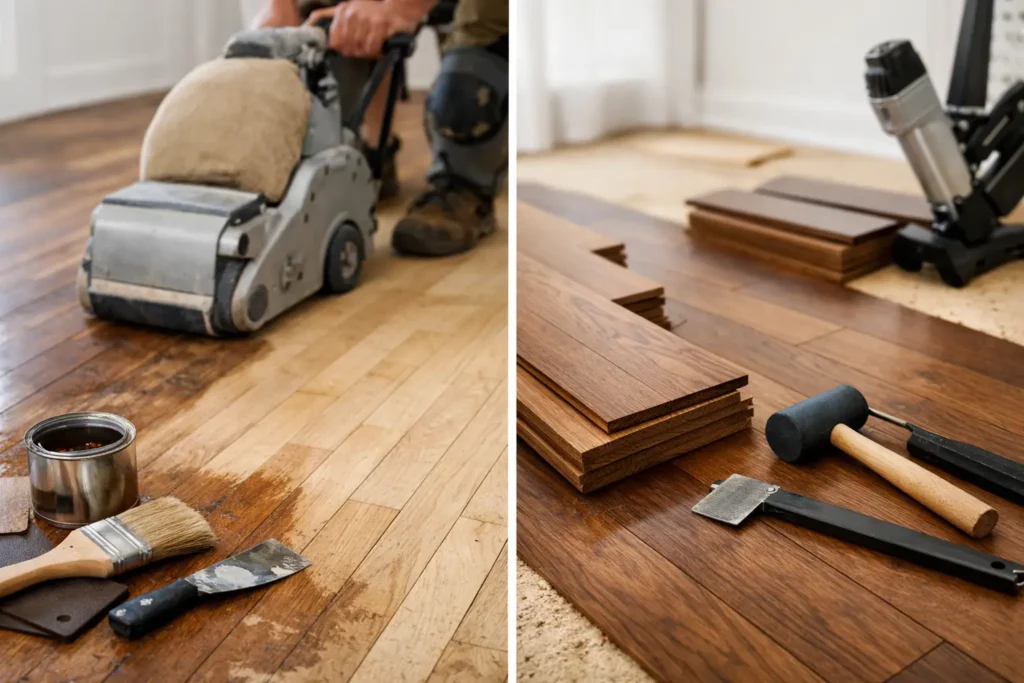
In most cases, refinishing costs significantly less than replacement because you are keeping the existing wood in place. You are paying for sanding, stain if desired, repairs where needed, and a new protective finish. Replacement adds demolition, disposal, subfloor prep, new materials, installation, sanding for unfinished wood if applicable, and finishing. That is a much bigger scope of work.
For homeowners, the simplest way to think about it is this: refinishing updates the surface and restores the beauty of a floor that still has good structure. Replacement is a full rebuild. One is restoration. The other is reconstruction.
That cost difference matters even more in larger homes or in open first-floor layouts where hardwood runs through multiple connected rooms. A project that may be very reasonable to refinish can become a much larger investment when every square foot has to be removed and reinstalled.
When refinishing is usually the smarter investment
Refinishing makes sense when the floor has cosmetic wear but is still fundamentally healthy. Scratches, dull finish, light pet wear, faded color, minor surface stains, and normal aging are all common reasons to refinish instead of replace. Even many older hardwood floors that look far past their prime can be restored dramatically.
This is where homeowners often leave money on the table. They assume an older floor is finished simply because it looks worn out. In reality, hardwood is one of the few flooring materials that can often be renewed rather than discarded.
A major advantage is that refinishing lets you transform the look of the room without paying for new wood. You can keep a classic natural tone, go darker, brighten the space with a lighter color, or choose a modern matte finish. The visual impact can feel like a full remodel, but the budget usually stays much closer to a restoration project.
For families, there is another factor beyond price. A professional dustless sanding system changes the experience completely. Dustless Hardwood Floors LLC uses a proprietary dustless sanding system that leaves zero dust in the home, which is a major benefit for households with children, pets, and allergy concerns. That means homeowners can restore beautiful existing floors without turning the house into a cleanup project.
When replacement is worth the extra cost
Replacement earns its keep when the floor has structural problems, severe damage, or the wrong material entirely. If boards are badly warped, repeatedly water-damaged, soft from long-term moisture exposure, or too thin to sand again, refinishing may not be the responsible recommendation.
Some floors also have extensive patching from past repairs, missing sections, or uneven materials added over time. In those situations, refinishing can improve appearance, but it may not create the consistent result homeowners want. Replacement may be the better long-term investment if your goal is a uniform floor throughout the space.
Another reason to replace is layout change. If you are removing walls, extending hardwood into new rooms, or replacing an outdated floor plan with a more cohesive design, installing new flooring can make more sense than trying to preserve smaller disconnected areas.
The key is not whether replacement is more expensive. It almost always is. The real question is whether replacement solves problems refinishing cannot.
What affects refinishing cost
Refinishing prices are shaped by condition, square footage, repair needs, stain selection, and finish system. A straightforward floor in decent shape costs less than one with deep gouges, pet stains, board replacement needs, or detailed edge work.
The species and age of the wood can also matter. Some older floors need more careful handling. Homes with multiple small rooms, stairs, or tight transitions may also require more labor than an open rectangle.
Then there is the quality of the process. Homeowners comparing quotes should pay attention to what is actually included. Clean containment, professional prep, dustless sanding, repair work, stain application, finish coats, and clear pricing all affect value. The lowest number on paper is not always the lowest real cost if the finish quality is poor or unexpected add-ons appear later.
What affects replacement cost
Replacement has more moving parts, so the price range is broader. First comes removal of the old floor and disposal. Then there may be subfloor leveling or repair. After that, material cost becomes a major variable. Basic hardwood and premium hardwood can be worlds apart in price.
Installation method matters too. Site-finished hardwood may require installation, sanding, staining, and finishing. Prefinished flooring can shorten some steps but may cost more per square foot depending on the product. Transitions, trim adjustments, furniture moving, and changes in floor height can also add to the total.
If you are replacing only part of a home, another hidden cost is matching. Sometimes it is difficult or impossible to match existing hardwood closely enough, which can push the project toward replacing more area than you originally planned.
Which option adds more home value?
Both can add value, but refinishing often delivers the better return because the investment is lower. Freshly refinished hardwood has strong visual appeal for buyers. It makes a home feel cleaner, better maintained, and more move-in ready.
Replacement can add value too, especially if the current floor is beyond repair or the home has mismatched materials that hurt the overall look. But from a return-on-investment perspective, replacement has a higher threshold to clear. You are spending much more upfront, so the payoff has to justify it.
For Connecticut homeowners preparing to sell, refinishing is often the sharper financial move when the original hardwood is still salvageable. It improves presentation without pushing renovation costs too far.
Hardwood refinishing vs replacement cost by homeowner goal
If your main goal is to make the floors beautiful again, refinishing is usually the first option to explore. If your main goal is to solve deep structural issues or completely change the wood itself, replacement may be worth the added cost.
If you want the best balance of beauty, value, and practicality, refinishing tends to win. If you want a different plank width, a new species, major layout continuity, or a reset after severe damage, replacement becomes more logical.
This is why a one-size-fits-all answer does not work. The cheapest option is not always the best option, and the most expensive option is not automatically the smartest one. The condition of the existing floor should lead the decision.
How to make the right call before you spend
Start with the wood itself. Ask whether the floor is solid enough to keep, whether the damage is mostly on the surface, and whether past sanding has left enough thickness for another refinish. Then think about your goals. Do you want restoration, redesign, or repair of a serious problem?
A professional on-site evaluation is usually the fastest way to get clarity. An experienced hardwood contractor can tell you whether the floor is a strong candidate for refinishing, what repairs are realistic, and when replacement is the wiser path. That guidance is especially important in older Connecticut homes, where original hardwood often has more life left than homeowners realize.
For many households, the best outcome is keeping the existing hardwood and restoring it with a clean, high-quality dustless process that leaves zero dust in the home. You protect your investment, avoid unnecessary replacement costs, and get the rich, renewed look hardwood is known for.
If your floors are worn but still worth saving, that is usually where the smartest money goes. The best flooring decision is not the one that sounds biggest. It is the one that gives you lasting beauty, a clean experience, and the right result for your home.
By understanding the hardwood refinishing vs replacement cost, you can make smarter home improvement choices.
Evaluating the hardwood refinishing vs replacement cost ensures you choose the right path for your flooring.
With the hardwood refinishing vs replacement cost in mind, you can better strategize your home’s flooring needs.
When weighing your options, remember the hardwood refinishing vs replacement cost to make an informed choice.
Many decisions in home improvement hinge on the hardwood refinishing vs replacement cost analysis.
Considering the hardwood refinishing vs replacement cost will help you achieve a balance of quality and price.
Evaluating the hardwood refinishing vs replacement cost can lead to long-term satisfaction with your floors.
Ultimately, the hardwood refinishing vs replacement cost should be a deciding factor in your flooring decisions.
Many homeowners find that understanding the hardwood refinishing vs replacement cost saves them money.
In summary, the hardwood refinishing vs replacement cost is a critical aspect of maintaining your flooring.
Ultimately, the hardwood refinishing vs replacement cost will guide your renovation strategy.
Understanding the hardwood refinishing vs replacement cost allows homeowners to choose the best option for their needs.
It’s important to evaluate the hardwood refinishing vs replacement cost before making a final decision.
Comparing the hardwood refinishing vs replacement cost is essential for homeowners looking to maximize their value.
Many homeowners underestimate the hardwood refinishing vs replacement cost and opt for replacement without considering refinishing.
In the debate of hardwood refinishing vs replacement cost, refinishing often prevails due to its lower price point.
Many experts emphasize the hardwood refinishing vs replacement cost when advising homeowners on floor care.
Understanding the hardwood refinishing vs replacement cost can help you make better decisions for your home.
When considering the hardwood refinishing vs replacement cost, many homeowners find that refinishing offers a more affordable solution.