
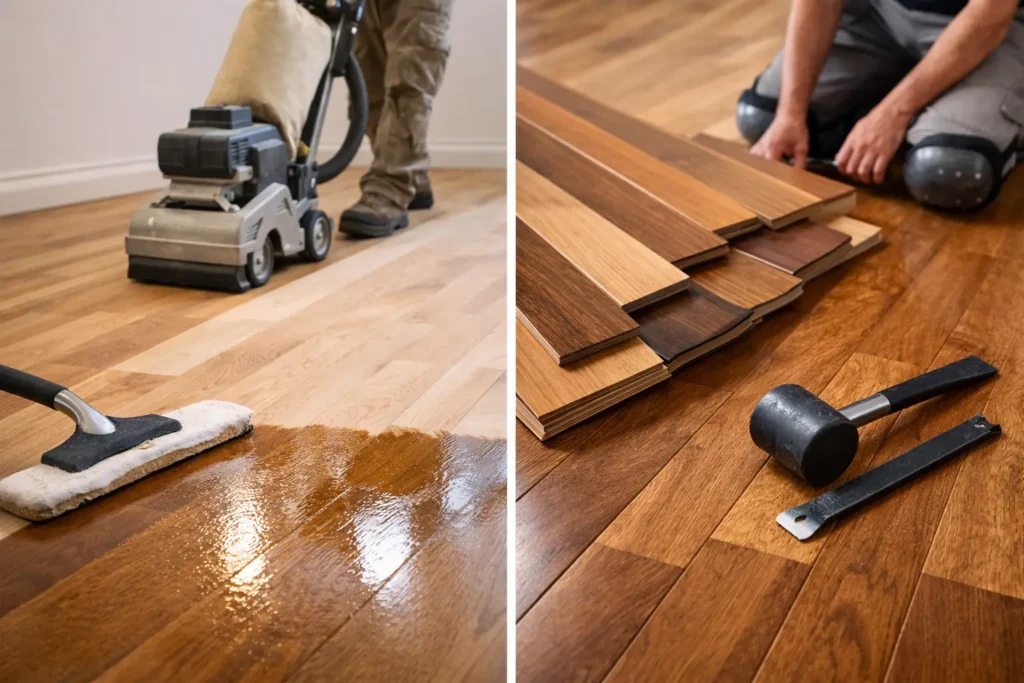
A new hardwood floor should make a room feel more finished, more valuable, and easier to enjoy—not leave you second-guessing the surface beneath your feet. In the site finished vs prefinished hardwood decision, the best choice depends on the look you want, the condition of your subfloor, your renovation schedule, and how much long-term flexibility matters to you.
For Connecticut homeowners, this is rarely just a color decision. Hardwood has to stand up to wet boots, active children, pets, furniture moves, dry winter air, and the everyday wear that gives a home character. Both options can deliver beautiful, durable floors. The difference is how the floor is finished, how the boards meet, and what the floor will need years from now.
Site Finished vs Prefinished Hardwood: The Core Difference
Prefinished hardwood arrives with its stain and protective coating already applied at the factory. The boards are installed as finished products, so there is no final sanding and coating process across the entire floor after installation. This can shorten the installation timeline and gives homeowners a predictable factory finish from the start.
Site finished hardwood is installed as unfinished wood, then sanded, stained if desired, and coated after the floor is in place. That final process creates one continuous finished surface across the room. It gives you more control over the color, sheen, and overall appearance of the floor.
Neither is automatically better. A carefully selected prefinished product can be an excellent fit for a straightforward installation. Site finishing is often the stronger choice when the home needs custom color matching, a level visual plane between boards, or restoration work that calls for precision.
Why the Finished Surface Looks Different
The most visible difference is usually at the seams. Most prefinished hardwood boards have small beveled edges. Those eased edges protect the factory-applied finish during manufacturing, shipping, and installation, while also helping define each individual plank. Many homeowners like that traditional plank-by-plank look.
A site finished floor is sanded after installation, so the surface can be made smooth and continuous from board to board. There are no factory bevels separating the planks unless a specific design calls for them. This gives the room a more refined, unified appearance that works especially well in formal spaces, open floor plans, and homes with existing hardwood that needs to blend into an addition.
Custom color is another major advantage of site finishing. With prefinished flooring, you select from the colors offered by the manufacturer. With a site finished floor, you can choose a natural clear finish, a classic warm brown, a modern neutral, or a custom stain developed to complement cabinetry, trim, and adjacent rooms. This is particularly valuable when repairing or extending an existing floor rather than starting with a completely blank space.
The advantage of seeing the color in your home
Flooring samples are useful, but they cannot fully predict how a color will look beside your walls, windows, lighting, and furnishings. A site-finished floor allows for stain samples on the actual wood in the actual room. That reduces the risk of committing to a color that looks different once it covers hundreds of square feet.
Durability Is More Than a Factory Finish
Prefinished flooring is often marketed for its durable factory coating, and quality products can perform very well. Factory-controlled application can produce a consistent finish, and some products include enhanced wear layers. But durability is not determined by the label alone. The species of wood, plank thickness, installation quality, room use, and routine care all matter.
Site finished hardwood can also provide excellent long-term protection when it is professionally sanded and coated with the right finish system. It offers another practical benefit: because the boards are finished together after installation, the protective layer helps seal the joints across the floor. In kitchens, entryways, and family rooms, that continuous finish can make routine cleanup more forgiving.
For households with dogs, children, or frequent guests, it is wise to focus less on promises of a “scratch-proof” floor and more on a realistic plan. All real hardwood can show wear over time. The right finish, sheen level, wood species, and maintenance routine help wear develop gradually and attractively instead of becoming an immediate concern.
Choosing matte and lower-sheen finishes is often a smart choice for active homes because they tend to make minor marks and everyday traffic less noticeable than high-gloss surfaces. A professional can help you balance the polished look you want with the practical performance your household needs.
Connecticut Flooring Timelines and Property Comfort
If timing is the only priority, prefinished hardwood may have an edge. Once it is installed, the main flooring surface is already coated, which can make it a practical choice for certain fast-moving renovation schedules or occupied properties.
Site finished flooring takes additional on-site steps, but it also gives you the ability to correct minor height variations, create a smooth surface, and achieve a tailored final result. The key is choosing a contractor with a process designed around the home, not just the floor.
At Dustless Hardwood Floors LLC, our proprietary dustless sanding and refinishing system leaves zero dust in the home. State-of-the-art containment machinery captures particles at the source while we prepare hardwood for a smooth, beautiful finish. That means families from Manchester to West Hartford can enjoy the custom elegance of a site-finished surface without a lingering cleanup mess or airborne respiratory irritants.
For homeowners concerned about odor, finish selection also matters. Eco-friendly, low-VOC waterborne finishing options can help make the project more comfortable while still delivering the premium protection and appearance your floor needs. Before work begins, a licensed flooring professional should explain the schedule, curing expectations, room access, and care instructions clearly.
Hardwood Floor Repair and Future Refinishing
This is where the site finished vs prefinished hardwood choice becomes more personal. Prefinished boards can be convenient to replace when hardwood floor damage is isolated and a matching product is still available. However, matching a discontinued color, sheen, or bevel profile years later can be difficult. Even the same product can age differently after exposure to sunlight and daily use.
Site finished floors are often easier to blend during a repair or future refinishing project because the surface can be sanded and stained as a whole. If a water mark, deep scratch, or worn traffic path develops later, a professional has more room to restore a consistent appearance across the affected area.
That does not mean prefinished floors cannot be refinished. Many solid and engineered prefinished floors can be refinished, depending on the thickness of the wear layer and the product construction. The important step is having the floor evaluated before making assumptions. A qualified contractor can identify whether your wood surface needs a minor restoration, a board repair, or a full advanced dustless sanding and refinishing plan.
Which Option Fits Your Connecticut Home?
- Choose prefinished hardwood when you want a faster installation window, prefer a specific factory color palette, and like the clear visual definition created by micro-beveled plank edges. It remains a strong option for busy commercial spaces or quick residential updates.
- Choose site finished hardwood when a custom color match, smooth floor plane, seamless repair blending, or direct extension to existing historic wood is the priority. It is ideal for homeowners who want to view stain samples under their exact room lighting before finalizing their investment.
As an active, licensed and insured home improvement contractor (HIC#0640958) following structural National Wood Flooring Association (NWFA) standards since 2006, our team provides transparent estimates and step-by-step guidance to ensure your project stands the test of time.