
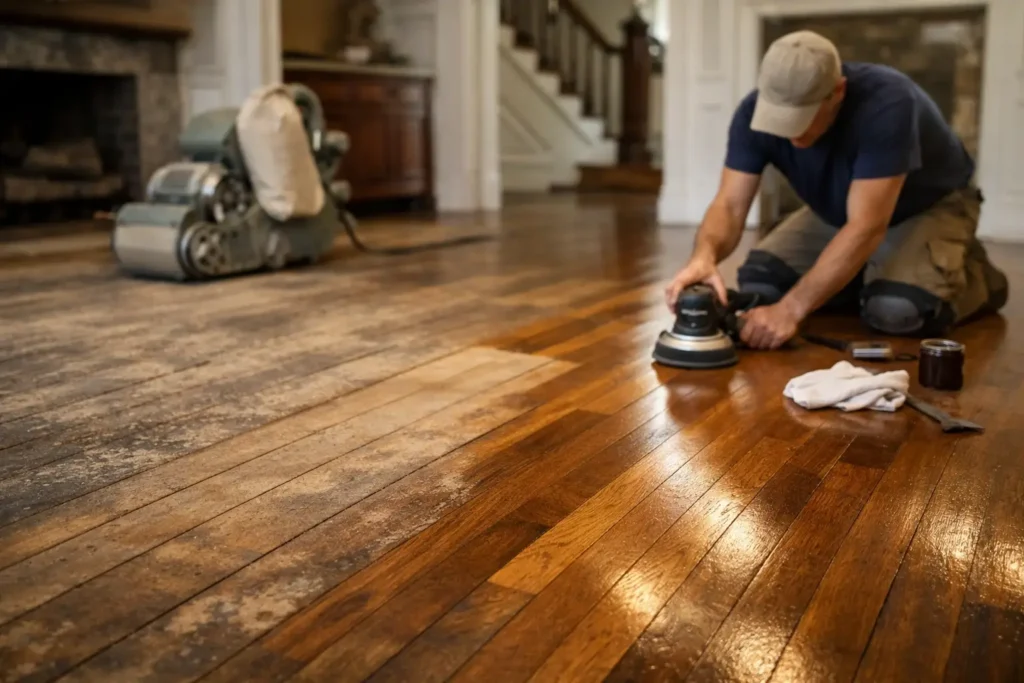
The moment an old floor starts showing its age, homeowners face a real question: preserve the character or start over? A good historic home floor restoration guide begins there, because older hardwood floors are not just a surface underfoot. They hold saw marks, board widths, wood species, and wear patterns that newer materials cannot truly replicate.
In many Connecticut homes, especially in older neighborhoods around West Hartford, Manchester, Glastonbury, and greater Hartford County, original floors are one of the most valuable features in the house. They add warmth, authenticity, and resale appeal. But restoring them correctly takes restraint as much as skill. The goal is not to make a 120-year-old floor look brand new. The goal is to make it beautiful, sound, and appropriate to the home.
What a historic home floor restoration guide should help you decide
The first decision is whether the floor should be restored at all, or whether certain sections need repair before refinishing. Historic floors often have uneven color, old patching, stains near radiators, gaps from seasonal movement, and isolated board damage. None of those automatically mean replacement.
What matters is the floor’s remaining wear layer, its structural stability, and whether previous sanding has already taken it close to its limit. A floor that has been refinished many times may not tolerate another aggressive sanding. On the other hand, a floor with cosmetic wear but solid material left can often be restored beautifully.
This is where homeowners can get into trouble by judging only by appearance. Deep-looking scratches may be mostly in the finish. Dark water marks may be localized. Boards that seem beyond saving may only need selective repair. Historic restoration is about separating what is truly damaged from what is simply aged.
Start by identifying what you have
Not every old wood floor is the same. In historic Connecticut homes, you may find old-growth oak, maple, fir, pine, or mixed-width plank flooring. Each species reacts differently to sanding, stain, and finish. Pine dents more easily and carries a softer, more timeworn look. Maple can be less predictable with stain. Oak often refinishs well and accepts color more evenly.
Board width and cut matter too. Quarter-sawn boards, face-nailed planks, and hand-fitted repairs are all clues that the floor deserves a careful approach. If the wood has historic significance or unusual milling, preservation should take priority over trying to force a perfectly uniform appearance.
You also want to know what has been applied to the floor over time. Some older floors have layers of wax, shellac, oil-based finish, paint, or stain from multiple eras. That history affects how the next finish will bond and how much preparation is required.
Signs your floor is a strong candidate for restoration
A historic floor is usually worth restoring when the boards are still structurally sound, the damage is not widespread through the full thickness of the wood, and the floor still has enough life left for proper refinishing. Cupping, isolated pet stains, moderate surface wear, faded finish, small gaps, and localized board replacement are all common and often manageable.
Even a floor that looks tired can become one of the standout features of the home when the right process is used.
Signs repair may come before refinishing
Some issues need to be addressed first. Loose boards, chronic moisture damage, severe rot, active subfloor movement, and large sections of delamination or splitting should be repaired before any finish work begins. If the source of moisture is still active, refinishing too soon will only lead to recurring problems.
That is one reason historic floors benefit from a contractor who understands both preservation and performance. A beautiful finish means very little if the floor beneath it is still unstable.
The biggest mistake in historic floor restoration
The biggest mistake is overcorrecting. Many homeowners understandably want smooth, even color and a flawless finish. But historic homes often look best when their floors retain some visual history. A few earned imperfections can be part of the charm.
Trying to remove every stain, flatten every ripple, or sand away every sign of age can reduce the very character that makes the floor special. It can also shorten the life of the boards. Restoration should improve the floor without stripping away its story.
That does not mean accepting damage or poor workmanship. It means knowing when to preserve patina and when to correct real defects. There is a balance, and that balance depends on the age of the home, the species of wood, and the homeowner’s goals.
Why dustless sanding matters in older homes
A historic home floor restoration guide would be incomplete without addressing cleanliness and indoor air quality. Older homes often have detailed trim, built-ins, original doors, and hard-to-clean architectural features. Families may also be living in the home during the project, with children, pets, or allergy-sensitive household members nearby.
That is why dustless sanding matters so much. A professional dustless sanding system leaves zero dust in the home, which helps protect the living environment while preserving the comfort of the space throughout the project. For homeowners who love their historic house but do not want the usual renovation stress, this is a major advantage.
It also supports better results. Clean containment helps maintain a more controlled refinishing environment and reduces the spread of residue through the rest of the home. For occupied properties, especially in Connecticut homes where people are balancing work, family, and renovation schedules, that cleaner process is often the difference between putting off the project and finally moving forward.
Choosing the right finish for a historic home
The right finish depends on how you use the house and what kind of look you want to preserve. Some homeowners want a traditional amber warmth that feels consistent with the age of the home. Others prefer a more natural matte finish that highlights the grain without making the floor look newly coated.
There is no single correct answer. High-gloss finishes can feel too modern in some historic settings, while matte or satin finishes often look more natural and forgiving. Stain choice also matters. Going darker can hide some inconsistency, but it can also make repairs and future wear more visible. A natural or medium tone often feels more timeless.
For family homes, finish durability is just as important as appearance. Entryways, kitchens, hallways, and homes with pets need a finish that can hold up to real life. A beautiful historic floor should still be practical.
Should you stain historic floors?
Sometimes yes, sometimes no. If the wood species has attractive natural character, leaving it close to its original tone may be the better choice. That is especially true when the floor includes old-growth material that already has depth and warmth.
Staining makes more sense when previous repairs have left color variation, when homeowners want a more cohesive appearance, or when the existing tone no longer suits the home. The trade-off is that stain can emphasize patchwork or species differences if not handled carefully.
Repair strategies that protect the home’s character
Good restoration often includes selective board replacement, not wholesale removal. If a few boards are beyond repair, matching the width, thickness, grain, and species as closely as possible helps the floor remain visually consistent. Reclaimed wood can sometimes be the best match, though availability varies.
Face nails, old cut nails, thresholds, and transitions should also be handled thoughtfully. Replacing these details with generic modern materials can make the floor feel disconnected from the rest of the house. The strongest restorations respect the original construction language of the home.
Color blending is another area where experience matters. New repairs should not stand out sharply, but they also should not be forced into an artificial uniformity that looks unnatural. In historic homes, perfect matching is not always realistic. Close, respectful matching is usually the right goal.
A practical timeline for homeowners
Historic floor projects can move efficiently, but older homes sometimes reveal surprises once work begins. Previous patches, hidden fasteners, uneven board thickness, or old finish layers may require adjustments. That is normal.
What homeowners need is clear communication and a process that minimizes disruption. With a professional dustless sanding system, the work stays clean and far more comfortable for occupied homes. That matters whether you are restoring one formal dining room in West Hartford or preparing an entire vintage property in Manchester for sale.
A realistic plan should include evaluation, repair if needed, sanding at the appropriate depth, staining if selected, and finish application with proper cure time. Rushing any of those steps can compromise the result. Historic floors reward patience.
When restoration is worth the investment
If you are debating whether to restore or replace, think beyond immediate cost. Original hardwood floors are one of the few features in an older home that can improve both daily living and long-term value at the same time. They make rooms feel grounded, finished, and authentic.
Professional restoration is especially worthwhile when the original material is still present and the home’s character is part of its appeal. For Connecticut homeowners, that often means preserving craftsmanship that would be difficult and expensive to duplicate today. When the process is handled with care and completed using zero-dust sanding, the result is not just a cleaner floor. It is a home that feels more like itself again.
If your old floors still have good bones, do not assume age means replacement. Sometimes the smartest move is to restore what history already got right.