
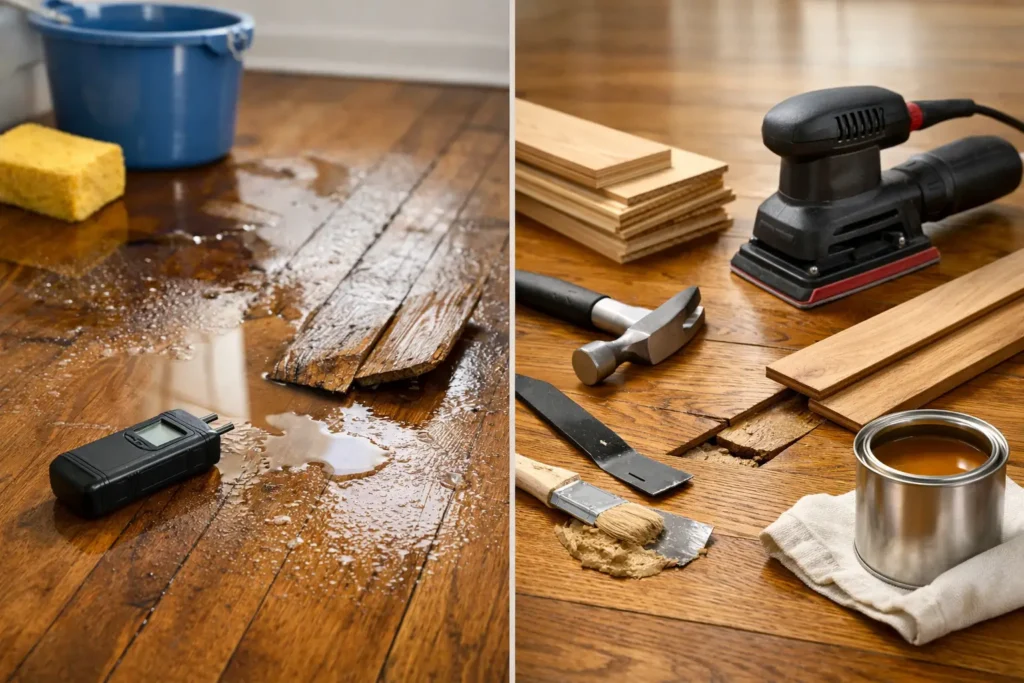
A small leak under the fridge can leave a much bigger problem than most Connecticut homeowners expect. Hardwood does not need a full flood to react. A slow drip, a wet boot tray, an overflowing plant, or a failed dishwasher line can darken boards, raise edges, and leave the floor looking permanently ruined.
The good news is that many damaged floors can be saved. The right repair depends on how much water got in, how long it sat there, and whether the damage is limited to the finish, the wood itself, or the subfloor below. If you are weighing water damaged hardwood floor repair options, the smartest first step is identifying what kind of damage you actually have. Understanding these factors is crucial in determining the best approach among the 7 water damaged hardwood floor fixes.
Considering the 7 water damaged hardwood floor fixes can help you make informed decisions regarding repairs.
Exploring the 7 water damaged hardwood floor fixes ensures that your hardwood remains in top condition.
What water damage looks like on hardwood
Not all water damage shows up the same way. Sometimes the finish turns cloudy or dull while the wood underneath is still sound. In other cases, boards cup at the edges, swell in the middle, stain black, or begin separating at the seams. A musty smell can point to moisture trapped below the floor, which changes the repair plan completely.
Timing matters. Fresh damage often gives you more repair choices. Long-standing moisture can lead to structural movement, recurring stains, or weakened boards that will not flatten back into place.
Water damaged hardwood floor repair options
Understanding the 7 water damaged hardwood floor fixes
The best solution is not always the biggest one. In many homes, a targeted repair followed by professional refinishing restores the floor beautifully without replacing the entire room.
1. Drying and monitoring the affected area
If the spill or leak was caught quickly, controlled drying may be enough to prevent lasting damage. This works best when the water stayed on the surface and did not soak deeply into the boards or subfloor. Fans, dehumidification, and moisture testing help determine whether the wood is stabilizing or still holding water.
This option is the least invasive, but it only works when action happens fast. If boards have already cupped, stained, or loosened, drying alone usually is not the finish line.
2. Spot repairs for isolated board damage
When only a few boards are affected, selective board replacement can be the most cost-effective path. This is common around sinks, entryways, dishwashers, and pet water bowls where damage stays concentrated in one area.
The challenge is matching the existing floor. Species, board width, grain pattern, stain color, and finish all need to blend. Done well, a spot repair can disappear into the rest of the room. Done poorly, it leaves a patch that always catches your eye.
3. Sanding away surface staining and finish failure
If the wood is still structurally sound and the damage is mostly in the top layer, sanding and refinishing can often restore the floor. This is especially true for light discoloration, shallow water marks, worn finish, and minor edge raise that settles once the floor dries.
For many homeowners, this is where the process matters as much as the result. Traditional sanding is a concern for families who do not want residue throughout the house. Dustless Hardwood Floors LLC uses a proprietary dustless sanding system that leaves zero dust in the home, which is a major advantage for households with children, pets, or allergy sensitivities. You get restored beauty without turning your living space into a cleanup project.
4. Board replacement plus refinishing
This is one of the most common repair paths for moderate damage. A contractor removes the worst boards, installs matching replacements, and then sands and refinishes the surrounding floor so the repaired area blends naturally.
It is a strong middle-ground option. You avoid tearing out an entire room, but you still get a uniform final appearance. This approach makes sense when some boards are beyond saving but the majority of the floor remains solid.
When cupping, crowning, and buckling change the answer
Water affects hardwood in stages. Cupping happens when board edges rise higher than the center, usually because moisture entered from below or stayed trapped in the wood. Crowning is the opposite – the center rises above the edges. Buckling is more severe, with boards lifting away from the subfloor.
These conditions are not all treated the same. Cupped boards sometimes flatten after proper drying, but sanding too soon can create permanent crowning later. Buckled boards often point to a larger moisture problem underneath and may require board removal, subfloor correction, and replacement.
This is where professional moisture readings matter. A floor should not be repaired based on appearance alone.
When full replacement makes more sense
Some floors are too far gone for a repair-first approach. If the boards are extensively warped, moldy, soft, or stained through the full thickness of the wood, replacement may be the better investment. The same is true if the subfloor has been compromised or moisture damage extends across multiple rooms.
Full replacement is not the first recommendation in most cases, and it should not be. But when repair costs start approaching the price of a new floor, replacement can deliver better long-term value and fewer surprises.
Signs replacement may be the smarter option
A floor is often a candidate for replacement when boards remain distorted after drying, large sections have separated, dark staining runs deep, or the subfloor shows water damage. Older floors that have already been sanded many times may also have limited material left for another refinishing cycle.
That does not mean the entire house needs to be redone. In some homes, replacement is limited to one room while adjacent hardwood is repaired and refinished for a cohesive look.
How to decide between repair and refinishing
Homeowners often ask the same question: can this be fixed, or do I need new floors? The honest answer is that it depends on four factors – depth of damage, square footage affected, age of the floor, and moisture conditions below the surface.
If the issue is mostly cosmetic, refinishing is often the best value. If the damage is localized, board replacement plus refinishing is usually the sweet spot. If the wood has structurally failed or the subfloor is involved, replacement becomes more likely.
The mistake is choosing too quickly. Sanding a floor that is still wet can make things worse. Replacing boards before the moisture source is corrected leads to repeat damage. A measured diagnosis saves money.
Why clean, dust-free restoration matters in occupied homes
Most hardwood repairs do not happen in empty houses. They happen where families are cooking dinner, helping with homework, and letting the dog in from the yard. That is why the repair method matters beyond the floor itself.
A dustless sanding system keeps the project cleaner and more comfortable while still delivering the smooth, consistent finish homeowners want. For busy households in Manchester, West Hartford, Glastonbury, and surrounding Connecticut communities, that means less stress and a safer environment for children, pets, and anyone sensitive to airborne particles. It also makes the restoration process feel far more manageable when you are trying to protect both your home and your schedule.
What to do right after you notice water damage
The first move is always to stop the source of water. After that, dry the area as quickly as possible and avoid assuming the floor is fine just because the surface looks better after a day or two. Moisture can remain trapped underneath.
Do not place rugs over the area, and do not rush into sanding or patching before the wood is evaluated. What looks like a minor cosmetic issue can actually be a moisture problem below the boards. On the other hand, what looks severe at first may improve enough with proper drying to avoid major replacement.
Getting the repair right the first time
Hardwood is durable, but water changes the equation. The best repair is the one that fits the actual damage, not the one that sounds fastest or cheapest in the moment. Sometimes that means drying and monitoring. Sometimes it means replacing a few boards and blending the repair with dustless sanding and refinishing. And sometimes it means knowing when replacement is the better long-term call.
If your floor has taken on water, treat it like a restoration decision, not just a cleanup task. A careful assessment today can save a beautiful floor and spare you from paying twice for the same problem.
Consider all relevant water damaged hardwood floor repair options before making a final decision.
Deciding on the best course of action regarding water damaged hardwood floor repair options can ensure long-lasting results.
Ultimately, the goal is to evaluate your water damaged hardwood floor repair options and find the best fit for your situation.
Researching different water damaged hardwood floor repair options is crucial for sustaining the quality of your floors.
There are various water damaged hardwood floor repair options that can help restore your home to its original beauty.
Consulting with experts can reveal the most effective water damaged hardwood floor repair options for your needs.
Evaluating multiple water damaged hardwood floor repair options will lead to a successful restoration process.
The right professional can guide you through the various water damaged hardwood floor repair options available to you.
Ultimately, knowing your options will empower you to make informed choices about water damaged hardwood floor repair options.
Recognizing the signs of damage will help you choose the appropriate water damaged hardwood floor repair options.
Some water damaged hardwood floor repair options may be more suitable for older floors than others.
Being informed about various water damaged hardwood floor repair options can help homeowners make the right decision.
Consider reaching out to professionals to discuss your water damaged hardwood floor repair options.
Exploring all water damaged hardwood floor repair options will ensure the best outcome for your flooring.
Understanding your water damaged hardwood floor repair options is essential for effective restoration.
Homeowners should be aware of various water damaged hardwood floor repair options that can help restore their floors.
In order to choose the best water damaged hardwood floor repair options, inspect all affected areas thoroughly.
Utilizing water damaged hardwood floor repair options can save you time and money in the long run.
When considering water damaged hardwood floor repair options, it’s important to evaluate the extent of the damage before proceeding.